
Iranian Strikes on Israel Signal a Dangerous Shift in Global Security
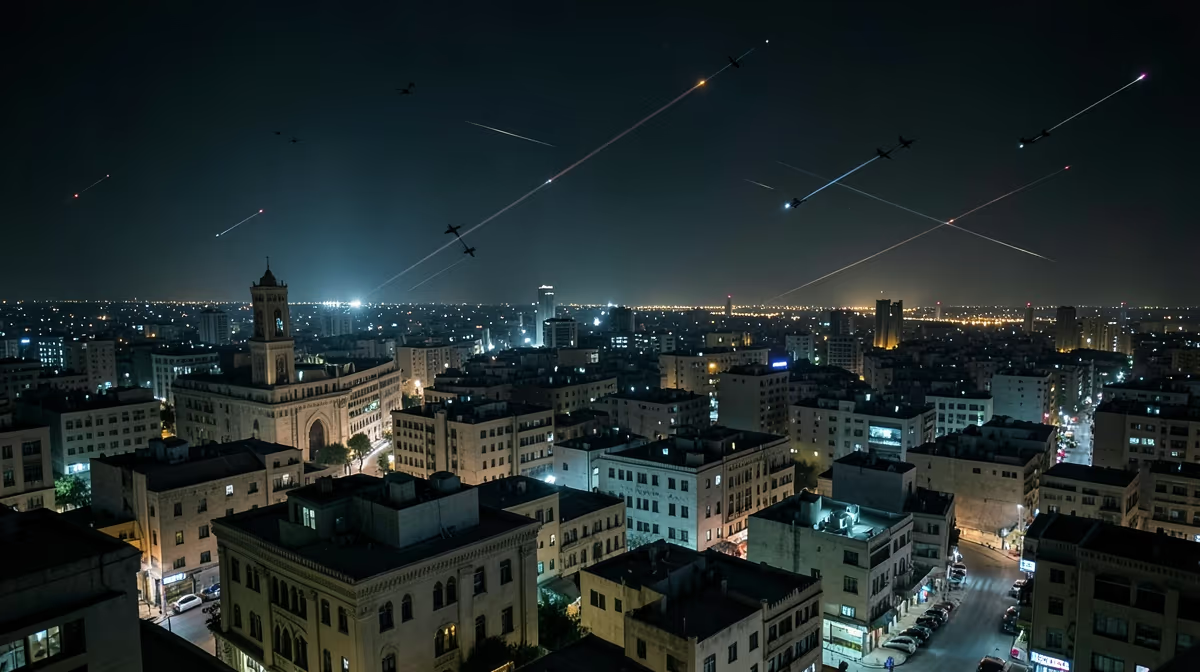
The landscape of Middle Eastern security shifted irrevocably this weekend as Tehran launched a massive, coordinated aerial assault against Israel, marking the first time the Iranian state has directly targeted Israeli territory from its own soil. This unprecedented operation, which involved hundreds of drones and missiles, has ignited urgent international concern regarding a wider regional conflict and the potential for severe geopolitical escalation that could threaten global stability.
The Anatomy of the Escalation
The strikes were launched on Saturday in direct retaliation for an April 1st air strike on the Iranian consulate in Damascus, which resulted in the deaths of several high-ranking members of the Islamic Revolutionary Guard Corps. In response to what Tehran framed as an exercise of its right to self-defense under Article 51 of the United Nations Charter, Iran deployed a multi-layered attack involving over 300 projectiles. This barrage included a combination of loitering munitions, commonly referred to as suicide drones, alongside various types of ballistic and cruise missiles.
The military operation was designed to overwhelm air defense systems by launching diverse threats simultaneously. However, the outcome demonstrated the efficacy of a collaborative defense architecture. Israel, supported by tactical intelligence and interception efforts from the United States, the United Kingdom, and Jordan, successfully neutralized the vast majority of the incoming projectiles before they reached their intended targets. While minimal damage was reported at a military installation in southern Israel and a small number of civilians were treated for shock or minor injuries during the alarm period, the sheer scale of the assault signals a move away from the decades-long era of shadow warfare.
Strategic Calculus and Root Causes
The transition from covert operations to open state-on-state confrontation represents a fundamental shift in regional security. Analysts point to a core root cause: the assertion of regional hegemony and a strategy of deterrence against perceived existential threats from Israel and the United States. This current volatility is exacerbated by the collapse of formal diplomatic pathways that previously sought to manage nuclear and security de-escalation.
From a political perspective, the regime in Tehran appears to be utilizing external military escalation to consolidate domestic legitimacy. By framing these actions as a form of nationalist resistance against perceived foreign imperialism, the leadership seeks to suppress internal dissent. Simultaneously, this move forces global powers into binary alignment positions, effectively ending the grey zone era where proxy battles were the primary medium of conflict. The acceleration of domestic aerospace self-sufficiency in Iran, coupled with an expanding network of regional proxies, indicates a deliberate effort to bypass traditional sanctions through illicit military-industrial logistics, drawing historical parallels to the Tanker War of the 1980s.
Economic and Global Implications
The direct nature of this confrontation carries profound risks for global markets, particularly regarding energy prices and the security of maritime shipping lanes. Prolonged regional insecurity historically inflates insurance premiums for commercial vessels and complicates long-term investment in infrastructure projects across the Middle East. As global markets brace for volatility, the primary concern for policymakers is that the cycle of retaliatory strikes could disrupt global energy supplies, impacting economies far beyond the immediate theater of operations.
The international community has responded with calls for immediate restraint. Global leaders have convened urgent meetings, with the United Nations Security Council scheduling an emergency session to address the situation. The diplomatic consensus currently favors de-escalation, yet the economic uncertainty surrounding the event remains a critical factor for investors tracking global security trends.
Predicting the Next Phase
The next 24 hours are expected to see an increase in aerial surveillance and a heightened state of military alert across the region as diplomatic channels work to restrain further movement toward total war. Experts anticipate that the next 72 hours will be decisive, carrying the potential for targeted secondary retaliatory strikes or kinetic exchanges. International powers are currently intensifying pressure on all parties to engage with regional intermediaries.
The best-case scenario involves all involved parties utilizing back-channel negotiations to establish a temporary ceasefire, shifting the momentum toward sustained diplomatic de-escalation. Conversely, the worst-case scenario warns that these calculated responses could spiral into a high-intensity conflict involving proxy networks and regional states, leading to a catastrophic disruption of global trade and energy supplies. At this stage, analysts believe the primary objective of these initial strikes was to demonstrate capability without triggering an uncontrollable, full-scale regional conflict.
Frequently Asked Questions
Why did Iran launch strikes against Israel?
Iran stated that its strikes were a direct retaliation for a suspected Israeli airstrike on its consulate in Damascus, Syria, which killed several high-ranking Iranian military officers. Tehran framed the action as an exercise of its right to self-defense under Article 51 of the UN Charter.
What weapons did Iran use in the recent strikes?
The strikes involved a combination of hundreds of loitering munitions, commonly known as suicide drones, alongside ballistic and cruise missiles. This multi-layered attack was designed to overwhelm air defense systems by launching different types of threats simultaneously.
What is the impact of Iranian strikes on regional stability?
These strikes significantly escalate tensions across the Middle East, moving the long-standing shadow war between the two nations into direct, public confrontation. The increased hostilities raise global concerns regarding potential disruptions to energy supplies and the risk of a wider regional conflict.
How did Israel defend against the Iranian missile attack?
Israel utilized its multi-layered air defense network, including the Iron Dome, David's Sling, and the Arrow system, to intercept the majority of the incoming threats. Furthermore, Israel received critical tactical support from international allies, including the United States, the United Kingdom, and Jordan, to neutralize the projectiles.
Is there a risk of a full-scale war following the Iranian strikes?
While the exchanges represent a major escalation, both sides have shown awareness of the catastrophic consequences of an all-out war. International diplomatic efforts are currently focused on de-escalation to prevent a cycle of retaliatory strikes that could draw in other regional powers.
How has the international community reacted to the Iranian strikes?
Global leaders have largely condemned the escalation, calling for immediate restraint to avoid further instability. Many nations have urged both parties to pursue diplomatic channels rather than continuing the cycle of direct military aggression.
Conclusion
The direct confrontation between Iran and Israel marks a dangerous new phase in Middle Eastern geopolitics. While the immediate threat of the recent aerial assault was largely mitigated by Israel’s defensive systems and the intervention of international allies, the broader security environment remains unstable. With global powers calling for restraint, the next few days will be defined by the effectiveness of diplomatic intervention versus the momentum of potential retaliatory cycles. Moving forward, observers are monitoring the extent of any future Israeli response and the capacity of regional intermediaries to prevent the current tension from escalating into a wider, more destructive conflict.


.webp)


.webp)
