
Skyroot Vikram 1 Rocket Launch Sets Stage for India's Space Future
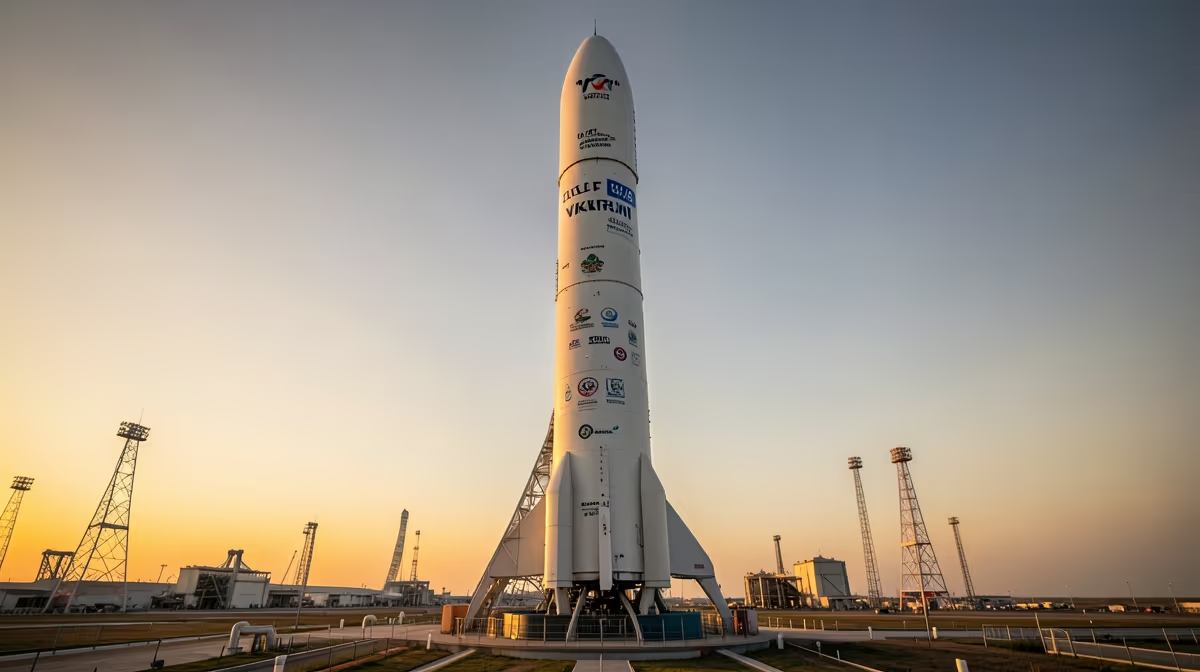
Deep within the industrial corridors of Hyderabad, a quiet revolution is taking shape that promises to alter the trajectory of global aerospace commerce. The upcoming skyroot vikram 1 rocket launch marks a historic milestone for the nation's space sector, signaling a massive leap forward for private space launch India capabilities as the country shifts toward a more competitive and agile market.
The Vision of Skyroot Aerospace CEO Pawan Kumar Chandana
The architect behind this transition is Pawan Kumar Chandana, co-founder of Skyroot Aerospace, who has consistently championed the democratization of space. His vision for the company is not merely to launch payloads but to redefine the logistics of the low-Earth orbit economy. Under his leadership, the firm has moved from a startup concept to a key player in the national aerospace landscape. Chandana has framed the Vikram series as a vital tool for the global small-satellite market, focusing on the necessity for rapid, affordable, and frequent launch capabilities. This approach mirrors the Silicon Valley NewSpace movement of the early 2000s, pushing the boundaries of what a private startup can achieve when given access to government-developed infrastructure.
Technical Specifications of the Vikram 1 Launch Vehicle
Vikram 1 is a sophisticated multi-stage orbital launch vehicle designed specifically to carry small satellites into low Earth orbit. The engineering philosophy behind the rocket prioritizes weight reduction and propulsion efficiency. By utilizing advanced carbon-fiber structures instead of traditional heavy metals, the vehicle achieves a superior strength-to-weight ratio. Furthermore, the rocket incorporates 3D-printed liquid propulsion engines, which allow for modular construction and reduced manufacturing complexity. This orbital-class vehicle is engineered to place payloads ranging from 300 to 800 kilograms into various orbits, offering a versatile platform for commercial and research institutions that require tailored deployment schedules.
Impact of Private Space Launch India Programs on Global Markets
The transition from a state-led space program to a model inclusive of private enterprise has significant economic and geopolitical implications. By lowering the barriers to entry for satellite deployment, India is positioning itself as a cost-effective, neutral hub for the Global South. This shift is not just about commercial satellite internet or weather monitoring; it is about strategic autonomy. By reducing reliance on foreign launch providers like SpaceX or Arianespace, India strengthens its technological sovereignty. Furthermore, the modular nature of the Vikram 1 technology provides rapid-response capabilities for surveillance and communications, offering a strategic advantage in an increasingly crowded orbital environment. The ripple effects of this industry shift will likely influence the entire supply chain, from satellite manufacturers to agricultural technology startups that rely on space-based data to drive economic growth.
The Regulatory Evolution and Historical Context
The current momentum is rooted in the 2020 Indian government decision to open the space sector to private players through the creation of IN-SPACe. This regulatory reform provided the necessary legal framework for startups to access ISRO facilities and testing capabilities. The success of the Vikram-S sub-orbital mission in 2022 served as the proof-of-concept, validating the collaboration between ISRO and the private sector. This historical parallel highlights a shift away from the government-monopolized space infrastructure of the past toward a more commercialized ecosystem. The collaboration with established bodies like the Satish Dhawan Space Centre ensures that while the innovation is private, the foundational safety and launch expertise of the national space program remain central to the mission lifecycle.
Anticipated Milestones and Flight Readiness
In the next 24 hours, the focus remains on the completion of final pre-launch testing and vehicle integration at the Satish Dhawan Space Centre. This phase includes mandatory flight safety readiness reviews to ensure all systems are within parameters. Moving into the next 72 hours, observers expect the execution of the full launch sequence, telemetry verification, and post-launch orbital insertion analysis. Expert predictions suggest a high probability of successful flight, which would solidify the company’s reputation as a top-tier commercial launch provider. However, the mission is not without risks; a worst-case scenario involving a premature abort or launch failure could necessitate a re-evaluation of development timelines and funding confidence, highlighting the high-stakes nature of entering the global commercial launch market.
Frequently Asked Questions
What is the Skyroot Vikram 1 rocket?
Vikram 1 is a multi-stage orbital launch vehicle developed by Skyroot Aerospace, an Indian private spaceflight company. It is designed to provide cost-effective and reliable satellite launch services, specifically targeting the small satellite market.
Has the Skyroot Vikram 1 rocket launched yet?
As of early 2024, Skyroot Aerospace has successfully demonstrated its launch capabilities with the suborbital Vikram-S rocket. The maiden orbital launch of the Vikram 1 rocket is currently in the advanced stages of preparation and testing.
What is the payload capacity of Vikram 1?
Vikram 1 is designed to carry a payload of approximately 300 kilograms to a 500-kilometer Sun-Synchronous Polar Orbit (SSPO). Its modular design allows for flexibility in launching various types of small satellites.
Is Skyroot Aerospace a government agency?
No, Skyroot Aerospace is a private space technology company based in Hyderabad, India. It was the first private startup to successfully launch a rocket into space in India, operating in collaboration with the Indian Space Research Organisation (ISRO).
What makes the Vikram 1 rocket unique?
The Vikram 1 rocket utilizes advanced carbon composite structures and 3D-printed engines to maintain a lightweight profile. These technologies significantly reduce manufacturing time and production costs, making space access more affordable for commercial clients.
When is the next Skyroot Vikram 1 mission expected?
Skyroot Aerospace has indicated plans for the first orbital flight of Vikram 1 following extensive ground tests of its propulsion systems. Updates regarding specific launch timelines are typically shared by the company through their official social media channels and press releases.
Conclusion
The preparation for the Vikram 1 maiden orbital launch represents a defining moment for India's transition into a globally competitive, private-sector-led space economy. By successfully moving from sub-orbital trials to orbital-class readiness, Skyroot Aerospace is demonstrating the viability of cost-efficient, 3D-printed, and carbon-composite aerospace engineering. As the company continues its final integration and testing phases at the Satish Dhawan Space Centre, the eyes of the aerospace industry remain fixed on this mission as a barometer for the success of India's broader space sector reforms. Final launch timings depend on rigid safety clearances and meteorological conditions, yet the path toward expanding India's footprint in the global satellite launch market remains firmly in view.


.webp)


.webp)
