
SpaceX Starship Flight 13 Launch Sparks Critical New Aerospace Debate
Humanity is edging closer to routine interplanetary transport as commercial heavy-lift engineering passes through another high-stakes trial of fire and telemetry. The path to establishing a multi-planetary civilization rests entirely on whether massive reusable spacecraft can survive the brutal physical forces of orbital re-entry.
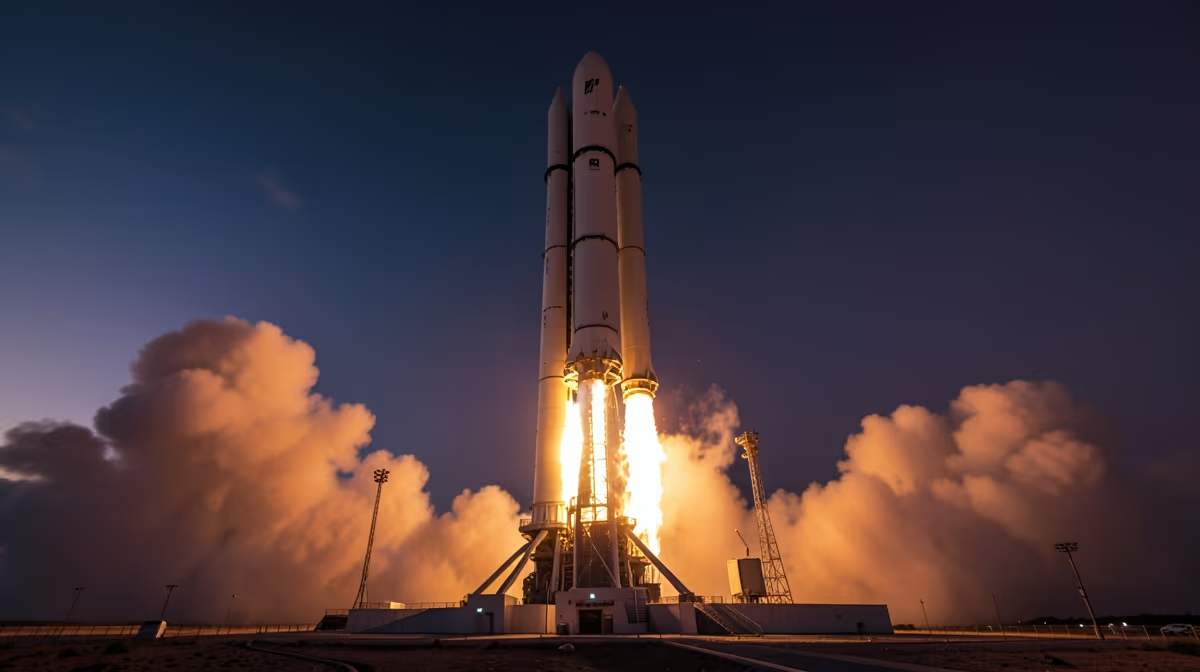
SpaceX successfully executed the Flight 13 test of its Starship megarocket from Starbase in Boca Chica, Texas, achieving critical milestone objectives in its ongoing development of the fully reusable deep-space transportation system. The launch, which took place during the designated operational window from the Gulf Coast launch site, showcased several key upgrades to both the Super Heavy booster and the Starship spacecraft. Engineers closely monitored the vehicle's thermal protection system and aerodynamic control surfaces during the high-speed descent phase over the ocean.
Telemetry data indicated that the primary separation events and hot-staging maneuvers proceeded according to computer models. Teams at mission control in Hawthorne, California, along with personnel on the ground in South Texas, analyzed real-time performance metrics as the vehicles navigated their planned suborbital trajectories. Data gathered from this mission will directly inform the iterative design process for future orbital flights, cargo deployments, and NASA's Artemis lunar landing architecture. SpaceX continues to maintain a rapid test cadence to meet the rigorous demands of commercial and government payload delivery schedules.
Engineering Breakdown And Technical Evolution
The root cause of many engineering challenges in this program involves rapid iterative hardware development encountering complex transonic aero-thermal limits during second-stage thermal protection system transition. Starship is the largest and most powerful rocket ever created, standing tall and aiming to eventually carry humans to the Moon and Mars. This mission marked the 13th flight test in the ongoing development program, with a primary focus on testing heat resistance and landing maneuvers.
Data collected during the flight helps engineers improve future rocket designs, even though no commercial cargo or human passengers were on board. The vehicle successfully cleared the launch mount, executed stage separation sequences, and provided crucial aerodynamic and thermal data during atmospheric re-entry. Full post-flight data analysis by SpaceX engineers is currently underway to determine the exact performance metrics of upgraded heat shield tiles and engine relight procedures. Each flight test brings the aerospace industry closer to a fully and rapidly reusable transportation system designed to carry crew and cargo to Earth orbit, the Moon, Mars, and beyond, as noted by SpaceX flight operations team members during the live broadcast of the launch.
Strategic Landscape And Geopolitical Forces
Beyond the raw engineering metrics, the commercial space sector operates within a web of complex geopolitical and economic pressures. The program's progression accelerates space race hegemony, directly challenging adversarial anti-satellite capabilities and widening the technological gap between US commercial space and European or Asian state programs. At the same time, political friction exists between legacy aerospace defense contractors, traditional congressional oversight, and the Department of Defense's increasing reliance on commercial disruption for strategic dominance.
This dynamic is paired with a subtle shift in environmental regulatory compliance tolerances by the Federal Aviation Administration to accommodate national security payload launch cadence demands. Economically, the initiative relies on the valuation stability of SpaceX's private equity, supply chain cost-per-ton-to-orbit efficiency gains, and the capital expenditure burn rate required for Mars-class infrastructure. These trials share a historical parallel with the early Atlas and Titan missile testing failures of the late 1950s that eventually laid the foundation for the Apollo program through aggressive trial-and-error.
Immediate Post-Flight Actions And Risk Scenarios
Following the completion of the flight profile, operational focus shifts immediately to ground inspections and regulatory review frameworks. Within the next 24 hours, SpaceX teams will begin post-flight data analysis, telemetry review, and hardware inspections at the Starbase facility in Boca Chica, Texas. Looking toward the next 72 hours, Federal Aviation Administration mishap investigation procedures may be initiated depending on the final flight outcome, while engineering teams compile comprehensive performance reports for both the Ship and Super Heavy booster.
Industry analysts expect incremental progress with key milestones achieved during atmospheric re-entry and controlled splashdown, validating iterative design changes. In a best-case scenario, all primary test objectives are met, including successful orbital insertion, precise controlled descent, and data capture for ship reuse, which accelerates the timeline for uncrewed lunar test flights. Conversely, in a worst-case scenario, an anomaly occurs during ascent or hot-staging, resulting in vehicle loss and triggering a prolonged Federal Aviation Administration grounding that delays subsequent test flights by several months.
Broader Societal And Industrial Impact
This test flight serves as a crucial stepping stone toward commercial interplanetary travel and future National Aeronautics and Space Administration missions to return humans to the Moon. If SpaceX can successfully master reusable heavy-lift rockets, the cost of launching satellites, scientific equipment, and eventually people into deep space will drop dramatically, opening the door to a space-faring economy.
The primary groups affected by these developments include space enthusiasts, the United States aerospace industry, National Aeronautics and Space Administration scientists relying on Starship for lunar missions, and communities near the launch site in Texas. SpaceX has been rapidly developing the Starship system through a test-fast, fail-fast iterative approach, launching successive prototypes from their Starbase facility in Boca Chica, Texas, to solve complex engineering challenges regarding reusability and orbital flight.
Frequently Asked Questions
When is SpaceX Starship Flight 13 scheduled to launch?
The official launch date for SpaceX Starship Flight 13 depends on the successful completion and Federal Aviation Administration approval of preceding test flights. SpaceX continues to iterate rapidly on its integrated flight stack at Starbase in Boca Chica, Texas. Therefore, exact scheduling is subject to change based on regulatory clearances and technical readiness.
What are the primary mission objectives for Starship Flight 13?
Key objectives for Flight 13 are expected to include improved thermal protection shielding, precise controlled booster catches, and simulated orbital payload deployments. SpaceX uses each flight test to gather critical telemetry data regarding hypersonic re-entry and ship maneuverability. These tests ultimately pave the way for fully operational, reusable flights and future Artemis lunar missions.
Will SpaceX attempt a Super Heavy booster catch on Flight 13?
SpaceX plans to continue utilizing the specialized Mechazilla launch tower arms to catch the Super Heavy booster, provided earlier missions validate the maneuver consistently. This catch technique is a cornerstone of SpaceX's rapid-reusability architecture for the Starship system. Success on Flight 13 would further confirm the reliability of this complex precision landing method.
Where does the SpaceX Starship launch from?
All major orbital-class Starship flight tests, including Flight 13, launch from SpaceX's private development and orbital launch facility known as Starbase. This facility is located near Boca Chica Beach in southeast Texas. The site features orbital launch mounts, cryogenic tank farms, and the massive integration towers required for stacking.
What improvements are expected on Starship Flight 13?
Flight 13 will likely incorporate upgraded second-generation heat shield tiles and redesigned flap mechanisms to survive the intense thermal stress of re-entry. Engineers continuously refine the vehicle's aerodynamics, internal plumbing, and software based on flight data from previous missions. These iterative upgrades are designed to enhance overall structural integrity and safety.
How can I watch the live stream of the Starship Flight 13 launch?
SpaceX provides a live, high-definition broadcast of every Starship test flight on their official website and their designated channel on X. The stream typically begins about thirty minutes before liftoff and includes expert commentary explaining the flight milestones. Major news outlets and space journalism channels also restream and cover the event in real time.
Conclusion
SpaceX has successfully executed the Flight 13 test of its integrated megarocket system, gathering vital aerodynamic, thermal, and mechanical data from Starbase in Boca Chica, Texas. Confirmed developments from the mission highlight the successful execution of early flight profiles, stage separation sequences, and telemetry capture monitored by mission control teams. Realistic next steps involve immediate post-flight data analysis, hardware inspections, and coordination with regulatory agencies to prepare for subsequent integrated test flights.


