
Sukhoi Su-57 Fighter Re-Evaluation Signals Major Shift in Regional Defense
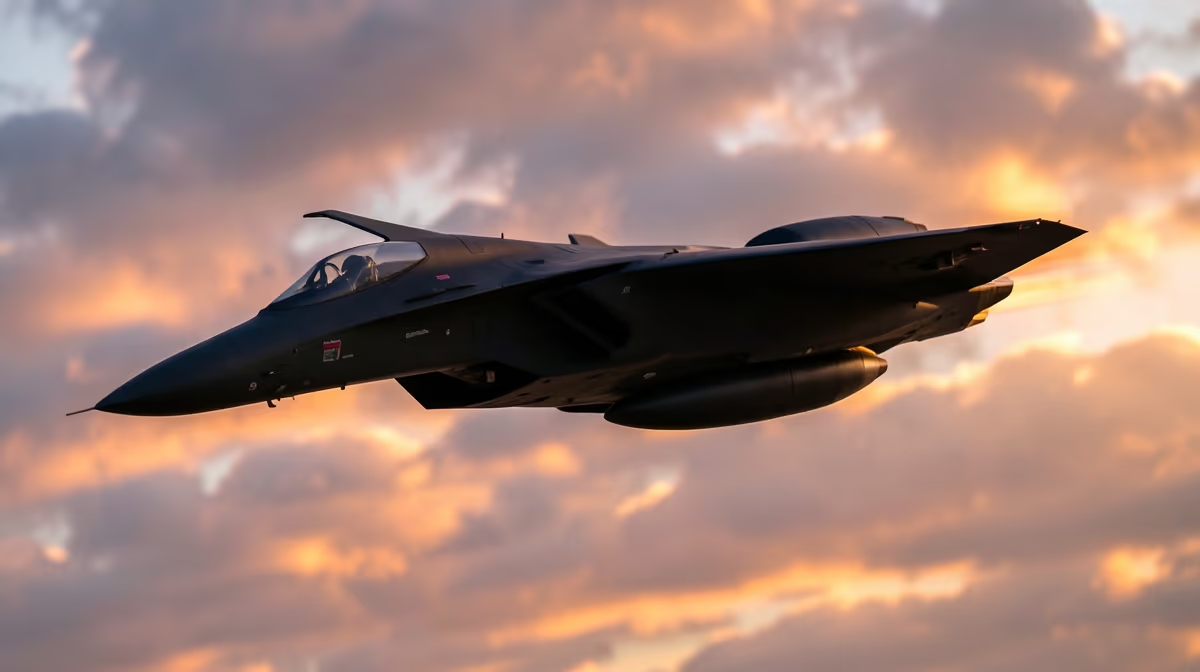
India has formally re-evaluated the Russian Sukhoi Su-57 fifth-generation stealth fighter for potential technology transfer and local production, amid evolving regional security dynamics and delays in indigenous aerospace programs, defense sources confirmed in New Delhi this week. Recent defense analysis highlights the strategic deployment of the sukhoi su-57 in modern air power scenarios, drawing intense scrutiny from military planners across the Indo-Pacific who are weighing the realities of modern air power against escalating geopolitical rivalries. The Sukhoi Su-57 is Russia's most advanced fighter jet, built to compete with top-tier stealth aircraft like the American F-35, utilizing advanced design principles to evade enemy radar, fly at supersonic speeds without using afterburners, and carry deadly weapons inside its internal body to stay hidden from tracking systems.
Strategic Re-Evaluation And Historical Context
The renewed discussions regarding the Sukhoi Su-57 come as the Indian Air Force seeks to bolster its dwindling fighter squadron strength to counter regional threats from neighboring adversaries developing advanced aerial platforms. India previously collaborated with Russia on the Fifth Generation Fighter Aircraft project based on the Su-57, before stepping away in 2018 due to concerns over cost, stealth capabilities, and technology sharing. This historical friction is rooted in India's historical reliance on Soviet and Russian defense technology combined with the urgent need to maintain air superiority over regional rivals like China and Pakistan amidst delays in indigenous programs like the AMCA. Development of the Su-57 began in the 2000s under Russia's PAK FA program to replace older Soviet-era jets like the MiG-29 and Su-27, with its first flight taking place in 2010 and limited service entry starting in late 2020. Defense Ministry officials speaking on condition of anonymity stated that any evaluation of foreign military hardware is strictly based on operational necessity and the extent of technology transfer offered to bolster domestic defense manufacturing capabilities.
Combat Readiness And Technical Specifications
Recent updates to the su-57, including combat deployments and the integration of advanced hypersonic weaponry by the Russian Aerospace Forces, have prompted defense planners in New Delhi to take a fresh look at the platform. The aircraft functions as a twin-engine stealth multirole fighter currently operational with the Russian Aerospace Forces, featuring advanced stealth technology to reduce radar visibility and a radar cross section optimized for low observability. It is capable of supercruise, meaning it can fly at supersonic speeds without afterburners, reaching a maximum speed of approximately Mach 2, which translates to about 2,140 kilometers per hour at altitude. The fighter is equipped with modern avionics and two tandem internal weapon bays running along the centerline of the fuselage to maintain its stealth profile while carrying air-to-air and air-to-surface missiles. While Russia promotes its combat abilities, defense experts around the world continue to debate how truly stealthy and mass-producible the platform really is, especially given that Russia operates a growing fleet of Su-57 fighters with deliveries steadily increasing as manufacturing plants scale up production to over twenty active aircraft.
Geopolitical Pressures And Economic Realities
Analysts note that Russia's willingness to offer deep technology transfer and joint manufacturing under the Make in India initiative makes the proposal more palatable than previous iterations, yet significant hurdles remain before any formal procurement process can begin. Defense analysts point out that Western sanctions on Russia complicate financial transactions and spare parts supply chains, while the Indian Air Force continues to prioritize its domestic Advanced Medium Combat Aircraft program to maintain technological sovereignty. This dynamic creates a delicate balancing act for New Delhi, which must navigate strategic autonomy and non-alignment with the necessity of keeping traditional defense ties with Moscow functional, while managing intense US pressure via CAATSA and diplomatic overtures. The economic dimension involves exorbitant lifecycle costs, technology transfer disputes, and the burden of joint development expenses that previously caused New Delhi to pull out of the FGFA program, contrasted with the potential domestic manufacturing benefits under Make in India. Furthermore, covert intelligence sharing and electronic warfare integration challenges present hidden obstacles that could expose sensitive Western-sourced avionics and communication systems if Russian fifth-generation technology were integrated into the Indian Air Force.
Implications For Global Air Power Dynamics
The debate surrounding fifth generation jet technology serves as a litmus test for India-Russia relations in a multipolar world, signaling to Washington and Beijing that New Delhi refuses to completely decouple its strategic assets from Moscow despite Western sanctions. For India, the Su-57 represents a complex defense choice as the nation balances local manufacturing goals with the urgent need for advanced fighter jets to match regional rivals. Globally, it shifts the balance of air power technology and influences multi-billion-dollar defense export markets, directly impacting the Indian Air Force, Indian defense policymakers, Russian defense manufacturers, and global geopolitical rivals watching the arms trade. Defense analysts and media in India are likely to react to emerging reports regarding Russian promotional efforts or technical updates on the fighter, particularly concerning potential export offers or joint development prospects over the next twenty-four hours. Discussions within Indian defense circles may intensify over the next seventy-two hours regarding whether the aircraft fits the Indian Air Force's Advanced Medium Combat Aircraft timeline and fifth-generation fighter requirements, especially given persistent delays in indigenous programs. Expert predictions suggest that India is unlikely to commit to large-scale procurement of the Su-57 due to prior friction over the FGFA program and a heavy policy focus on domestic manufacturing, though it may evaluate niche technological cooperation. In a best-case scenario, Russia offers substantial technology transfer and co-production terms that accelerate India's domestic fifth-generation fighter capabilities without compromising strategic autonomy, whereas a worst-case scenario involves relying on or reopening talks for imported stealth fighters that divert critical capital and political will away from India's indigenous AMCA program, leaving strategic air power gaps.
Frequently Asked Questions
What is the Sukhoi Su-57?
The Sukhoi Su-57 is a twin-engine stealth multirole fighter aircraft developed by Russia for air superiority and attack operations. It represents Russia's first aircraft to use stealth technology and is designed to counter advanced western fighters like the F-22 and F-35. The fighter incorporates supercruise, supermaneuverability, and advanced avionics to provide high combat effectiveness.
Is the Sukhoi Su-57 in service with the Indian Air Force?
No, the Sukhoi Su-57 is not currently in service with the Indian Air Force. India initially collaborated with Russia on the Fifth Generation Fighter Aircraft program, which was derived from the Su-57, but later withdrew from the project in 2018 due to cost and technology transfer concerns.
What is the top speed of the Sukhoi Su-57?
The maximum speed of the Sukhoi Su-57 is approximately Mach 2, which translates to about 2,140 kilometers per hour at altitude. It is also capable of sustained supercruise flight at supersonic speeds without using its afterburners. This high speed allows the aircraft to rapidly intercept targets and evade threats.
How does the Su-57 compare to the US F-35?
The Su-57 focuses heavily on supermaneuverability, raw speed, and a diverse heavy weapons payload, whereas the F-35 prioritizes advanced sensor fusion, network-centric warfare, and very low observable stealth. While the F-35 is generally considered superior in radar stealth and avionics integration, the Su-57 excels in aerodynamic agility and kinematic performance.
Does the Su-57 have internal weapon bays?
Yes, the Su-57 features two tandem internal weapon bays running along the centerline of the fuselage to maintain its stealth profile. These bays can carry a variety of air-to-air and air-to-surface missiles, while additional munitions can be mounted on external hardpoints when stealth is not required.
How many Su-57 fighter jets does Russia have?
Russia operates a growing fleet of Su-57 fighters, with deliveries steadily increasing as the manufacturing plants scale up production. While precise operational numbers fluctuate as new batches are delivered to the Russian Aerospace Forces, estimates place the active fleet at over twenty aircraft.
Conclusion
India has completed preliminary technical briefings and discussions with Russian defense representatives regarding the updated capabilities of the Sukhoi Su-57 stealth fighter, while actively developing its domestic Advanced Medium Combat Aircraft program. Although preliminary evaluations and technology transfer discussions remain under active inter-ministerial review, significant logistical and financial complexities driven by international sanctions and prior project withdrawals continue to influence New Delhi's procurement strategy. Defense planners will monitor whether the Ministry of Defence proceeds with formal frameworks or maintains its primary focus on domestic manufacturing under the Make in India initiative.


