
Cyber Attacks on Water Systems Pose Rising Threat to US Infrastructure
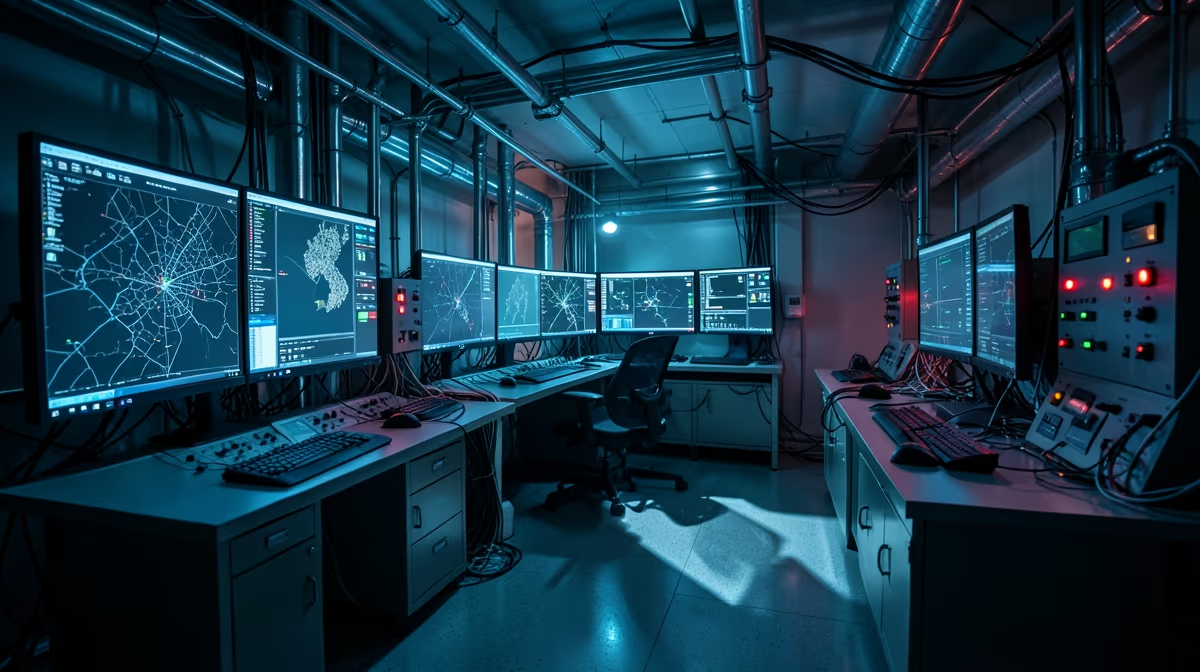
Federal agencies are sounding the alarm over a surge in cyber attacks on water systems, exposing critical vulnerabilities in municipal infrastructure. Behind the hum of industrial pumps and the steady flow of municipal distribution networks, an invisible digital war is being waged across the United States. Malicious actors are systematically probing the software foundations of local utilities, aiming at the very systems that process and deliver everyday drinking water to millions of citizens. While water facilities have long relied on physical security to protect reservoirs and treatment plants, their expanding digital footprint has transformed them into prime targets for hostile foreign and domestic entities.
What Unfolded
Federal cybersecurity agencies and water authorities across multiple U.S. states are urgently investigating a coordinated series of cyber intrusions targeting municipal water and wastewater treatment facilities, heightening national security concerns over critical infrastructure vulnerabilities. These cyber attacks, detected over the past week, have primarily targeted programmable logic controllers and human-machine interface systems used to monitor and regulate water treatment processes. While most facilities successfully isolated the affected systems and transitioned to manual operations before service disruptions occurred, at least one municipal utility experienced temporary operational anomalies that required immediate manual intervention to ensure water safety.
Cybersecurity experts and intelligence officials have attributed scanning and intrusion activities in specific incidents to foreign state-sponsored threat actors, including groups linked to Iran and China. These malicious cyber actors have increasingly focused on the U.S. water sector, exploiting default administrative passwords, unpatched software vulnerabilities, and exposed remote-access connections to gain unauthorized entry into operational technology networks. In response to the escalating threat landscape, the Environmental Protection Agency and the Cybersecurity and Infrastructure Security Agency have issued joint emergency directives mandating heightened network monitoring, mandatory password resets, and the immediate disconnection of vulnerable management systems from the public internet. State regulators are also conducting rapid compliance audits across hundreds of small and mid-sized water utilities, which often lack the dedicated cybersecurity resources of larger metropolitan agencies.
Historical Context and Root Causes
For decades, water treatment plants operated in isolation using closed systems. However, to improve efficiency and reduce costs, many facilities connected their operational technology to the internet, inadvertently opening the door to remote cyber threats that federal agencies are now scrambling to help secure. The roots of these vulnerabilities trace back to decades of deferred infrastructure maintenance, a reliance on legacy industrial control systems without default security architectures, and a severe shortage of specialized cybersecurity talent within municipal utilities. This history mirrors the 2015 and 2016 cyberattacks on Ukraine power grids by Russian state-backed actors, which served as a proving ground for weaponizing civilian infrastructure against a geopolitical rival. The timeline of intrusion attempts stretches across years, starting with Department of Homeland Security warnings in 2016 regarding foreign reconnaissance against U.S. water dams and treatment facilities, followed by unauthorized access attempts at the Oldsmar, Florida water treatment plant in 2021 that exposed the dangers of remote desktop software vulnerabilities. By 2023, the EPA issued an enforcement alert after finding widespread cybersecurity vulnerabilities in over 70 percent of inspected water systems, leading directly to the routine exploitation of default credentials and unpatched programmable logic controllers by foreign-linked hacktivists today.
Why This Matters
Water is our most essential daily resource, and a successful large-scale cyber attack could cut off access to clean drinking water, shut down firefighting systems, or even cause dangerous chemicals to be mixed into the water supply. Protecting these systems is critical not just for public health, but for national security and the daily functioning of society. The local communities, residents whose homes and businesses rely on municipal water, local government utilities, and schools or hospitals that depend on uninterrupted water service are all directly affected. EPA Administrator Michael S. Regan emphasized the gravity of the situation during an emergency briefing, stating that the targeting of the nation's water and wastewater systems is a direct threat to public health and national security, and noting that officials are working around the clock with state and local partners to harden these vital networks against hostile foreign and domestic actors.
Analyst Perspective
Examining the multi-dimensional aspects of these intrusions reveals deep systemic friction points. From a political angle, there is ongoing tension between federal cybersecurity mandates and local municipal sovereignty, where cash-strapped cities resist unfunded federal compliance requirements while local politicians deflect blame for critical infrastructure vulnerabilities. Economically, this manifests as asymmetric financial warfare where low-cost intrusion attempts force millions of dollars in emergency remediation, hardware upgrades, and legal liabilities onto vulnerable, tax-funded local water districts. Geopolitically, state-sponsored actors linked to Iran, China, and Russia are normalizing critical infrastructure probing to establish persistent pre-positioning for potential future asymmetric conflict. Furthermore, a hidden angle involves the heavy reliance of municipal water treatment plants on third-party integrators and remote-monitoring software vendors, creating a soft underbelly of supply chain vulnerabilities that bypass perimeter defenses.
Future Outlook
Looking ahead, federal agencies are preparing for swift operational adjustments. Over the next 24 hours, federal bodies are expected to issue an urgent joint advisory highlighting specific vulnerabilities in water treatment supervisory control and data acquisition systems, prompting facility operators to conduct immediate offline backups and isolate remote management portals. Within 72 hours, state-level emergency management services are slated to establish dedicated incident response task forces to audit rural water districts, while cybersecurity vendors release emergency patches for targeted telemetry software. Long-term projections from experts suggest that threat actors will likely pivot from disruptive denial-of-service attacks to stealthy credential harvesting within water sector supply chains, prioritizing long-term persistence over immediate operational disruption. In a best-case scenario, proactive isolation of vulnerable interfaces prevents operational disruption, leading to a nationwide upgrade of default credentials and accelerated adoption of multi-factor authentication across small-to-medium municipal water districts. Conversely, a worst-case scenario involves a coordinated ransomware campaign successfully compromising chemical dosing controls in multiple rural water facilities, forcing temporary boil-water advisories and severely eroding public trust in critical infrastructure resilience.
Frequently Asked Questions
Are US water systems vulnerable to cyber attacks?
Yes, many US water and wastewater systems are vulnerable to cyber attacks due to outdated digital infrastructure and limited cybersecurity resources. Federal agencies like the EPA have issued urgent warnings regarding active threats from foreign and domestic threat actors targeting these critical utilities. Securing these systems is a top priority for national security because they directly impact public health and daily life.
What happens during a cyber attack on a water treatment plant?
During a cyber attack, hackers can potentially manipulate operational technology to alter chemical levels, such as increasing sodium hydroxide to dangerous amounts in the water supply. Attackers may also lock control systems using ransomware or disrupt remote monitoring capabilities, forcing operators to switch to manual controls. Fortunately, most modern plants have physical safeguards and manual overrides that prevent catastrophic contamination from reaching consumers.
Who is targeting US water infrastructure with cyber attacks?
US water infrastructure is frequently targeted by state-sponsored hacker groups from countries like Russia, China, and Iran, as well as financially motivated ransomware syndicates. These threat actors often probe industrial control systems to test vulnerabilities and establish footholds for potential future disruptions. Federal intelligence agencies actively monitor these groups and share threat intelligence with local utility operators to mitigate risks.
How are federal agencies responding to cyber threats against water systems?
The US government is responding by issuing enforceable cybersecurity standards, conducting mandatory sanitary surveys, and providing technical assistance and grants to cash-strapped utilities. The EPA and CISA are working closely with state regulators to help water systems identify vulnerabilities and implement robust incident response plans. Additionally, federal task forces are increasing intelligence sharing to disrupt malicious actors before they can compromise critical infrastructure.
What are the main cybersecurity challenges for small water utilities?
Small water utilities often struggle with a lack of dedicated cybersecurity personnel, insufficient budgets, and aging operational technology that was never designed to be connected to the internet. Many of these rural or municipal systems rely on third-party vendors for remote management, which can introduce hidden supply chain vulnerabilities. Bridging this gap requires increased federal funding, shared services models, and simplified security tools tailored for smaller operations.
How can water treatment facilities improve their cybersecurity posture?
Water facilities can significantly improve their security by implementing multi-factor authentication, segmenting their IT and operational technology networks, and conducting regular vulnerability assessments. Adopting frameworks like the NIST Cybersecurity Framework helps utilities prioritize risks and establish protocols for incident detection and recovery. Continuous staff training on phishing and social engineering is also essential to prevent initial unauthorized access.
Conclusion
Recent developments confirm that municipal water and wastewater facilities across the United States have experienced unauthorized cyber intrusions targeting operational technology networks, prompting joint emergency directives from the EPA and CISA. While no widespread contamination or prolonged disruptions to public drinking water supplies have been reported, investigations highlight active probing by foreign state-sponsored threat actors exploiting legacy vulnerabilities. Realistic next steps involve facility operators executing immediate offline backups, isolating remote management portals, conducting rapid compliance audits, and accelerating the adoption of multi-factor authentication and network segmentation to safeguard critical water infrastructure.


.webp)

