
Global Combat Air Programme Advances as BAE Systems Leads Sixth-Gen Jet
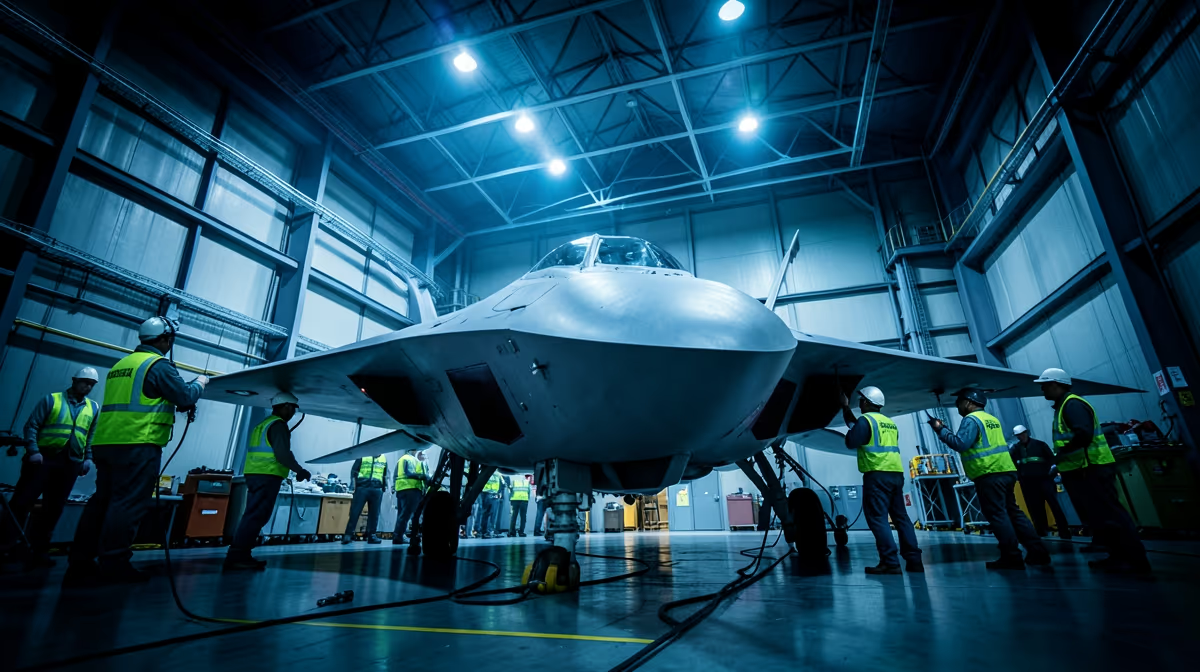
The global combat air programme continues to shape the future of military aviation, with BAE Systems leading critical advancements on the new gcap jet. Across three continents, defense strategists are quietly redrawing the blueprints of modern air dominance to counter an increasingly complex security environment.
Ministers from the United Kingdom, Italy, and Japan officially advanced their joint Global Combat Air Programme (GCAP) to develop a next-generation sixth-generation fighter jet by 2035, securing a major international defence partnership aimed at countering rising global security threats. This high-stakes trilateral initiative merges what was once the UK national Tempest project with allied efforts, establishing a unified technological and industrial front designed to maintain air superiority well into the twenty-first century.
Background
The roots of this unprecedented trilateral venture lie in a fundamental economic and technological realization. Medium-tier European and Asian powers recognized independently that fifth-generation fighter technology has become prohibitively expensive to develop alone. For the United Kingdom, this reality intersected with a post-Brexit industrial strategy imperative to anchor its high-value aerospace sector globally. The UK originally unveiled the Tempest concept in 2018 at the Farnborough Airshow as a national successor to the Eurofighter Typhoon. However, shifting geopolitical alliances and a desire to work with technological powerhouses like Japan led to the creation of GCAP in late 2022, merging British and Italian efforts with Japan's separate fighter jet program. This historical evolution mirrors the Panavia Tornado development of the 1970s, which forced European nations to pool resources and industrial capabilities to compete with American aerospace dominance, though GCAP introduces a novel trans-hemispheric dimension with Japan.
What Unfolded
The formalization of the partnership reached a critical milestone when ministers from the three nations signed a treaty in London establishing the GCAP International Government Organisation (GIGO), which will formally manage the delivery of the advanced combat aircraft. This collaborative effort combines the technological expertise of BAE Systems in the United Kingdom, Leonardo in Italy, and Mitsubishi Heavy Industries in Japan. The stealth aircraft, intended to replace the UK Royal Air Force's Typhoon and the Italian Air Force's equivalent fleets, will feature cutting-edge capabilities including autonomous flight options, advanced sensors, and integrated artificial intelligence. Funding and resource sharing remain central to the agreement, with each nation contributing proportionate industrial capabilities and financial investments. While development continues at a rapid pace, the partners are also in ongoing discussions with potential future international allies, including Saudi Arabia, about possible involvement in the ambitious aerospace project.
Key Facts And Core Capabilities
The Global Combat Air Programme is a trilateral international initiative involving the UK, Japan, and Italy. Its primary goal is to develop a next-generation stealth fighter jet to replace current aircraft like the UK's Typhoon and Japan's F-2, with operational deployment scheduled for 2035. The aircraft is not an ordinary warplane; it will feature advanced digital capabilities, artificial intelligence assistance, and the option to fly without a pilot. It is designed to dominate future skies by connecting with uncrewed systems, drones, satellites, and other military networks in real-time. Major defense companies including BAE Systems representing the UK, Leonardo for Italy, and Mitsubishi Heavy Industries for Japan are leading the engineering, working closely with avionics specialists and engine manufacturers like Rolls-Royce and Avio Aero. GCAP is not replacing the UK's Tempest concept, as Tempest has evolved directly into the UK contribution to the broader trilateral framework.
The Geopolitical And Economic Stakes
From a geopolitical perspective, the programme bridges Euro-Atlantic and Indo-Pacific security architectures, effectively creating a trans-regional deterrent network designed to counter simultaneous threats from peer adversaries like China and Russia while hedging against shifts in United States commitment. Politically, the initiative represents a delicate balancing act of national sovereignty versus shared burden-sharing. London, Tokyo, and Rome must navigate asymmetrical political cycles, domestic job pressures, and national pride while maintaining a unified procurement front. Economically, the project involves massive capital requirements, intellectual property sharing friction, and the risk of cost overruns distributed across tripartite budgets. These risks are weighed directly against the promise of sustaining hundreds of thousands of high-skill manufacturing jobs and securing future export markets. Beneath the surface, an intense subterranean turf war over supply chain dominance persists, particularly regarding how software integration, AI autonomy, and proprietary sensor data ownership will dictate which nation retains ultimate sovereign control over the jet operational capabilities.
Near Term Outlook And Operational Horizon
Short-term projections indicate that routine diplomatic consultations and bureaucratic alignment between the UK, Italy, and Japan will continue regarding project milestones for the Global Combat Air Programme. Over the next seventy-two hours, further technical discussions on supply chain integration and workshare distribution are scheduled among BAE Systems, Leonardo, and Mitsubishi Heavy Industries. Experts predict the programme will continue steady development phases, balancing complex trilateral industrial demands while navigating long-term budgetary and technological hurdles. The best-case trajectory involves seamless technological integration and finalized cost-sharing agreements that accelerate the prototype development phase without political friction. Conversely, the worst-case scenario entails potential disagreements over workshare distribution and escalating development costs leading to friction between partner nations and possible schedule delays.
Frequently Asked Questions
What is the Global Combat Air Programme?
The Global Combat Air Programme, or GCAP, is a trilateral international initiative involving the UK, Japan, and Italy. Its primary goal is to develop a next-generation stealth fighter jet to replace current aircraft like the UK's Typhoon and Japan's F-2. The ambition is to have this advanced combat aircraft operational by the year 2035.
Which countries are involved in GCAP?
The core nations participating in the Global Combat Air Programme are the United Kingdom, Japan, and Italy. These countries are pooling their technological expertise, industrial capabilities, and financial resources to build the future combat air system. Other international partners may join or collaborate on specific aspects of the project as development progresses.
When will the GCAP fighter jet enter service?
The Global Combat Air Programme aims to have its next-generation fighter jet operational by 2035. This is an ambitious timeline for a major defense aerospace project, requiring rapid advancements in digital design, manufacturing, and systems integration. Current phases focus heavily on research, technology maturation, and concept design.
What aircraft is GCAP replacing in the UK?
In the UK Royal Air Force, the GCAP platform, often referred to in the UK as Tempest, is intended to eventually replace the Eurofighter Typhoon. It will serve as the cornerstone of the UK's future air combat capability. The aircraft will operate alongside advanced uncrewed systems and existing assets.
Who are the main industrial partners for GCAP?
The primary industrial partners leading the development of the Global Combat Air Programme are BAE Systems representing the UK, Mitsubishi Heavy Industries for Japan, and Leonardo for Italy. These aerospace giants are collaborating closely with their respective supply chains, avionics specialists, and engine manufacturers like Rolls-Royce and Avio Aero.
Is GCAP replacing the Tempest jet?
GCAP is not replacing the Tempest; rather, Tempest has evolved into the UK's contribution to the broader Global Combat Air Programme. When the UK joined forces with Italy and Japan, the national Tempest project was merged into this new trilateral framework. Consequently, the UK's future fighter is now being jointly developed under the GCAP banner.
Conclusion
The Global Combat Air Programme has established its foundational governance through the treaty creating the GIGO, uniting the United Kingdom, Italy, and Japan in a shared mission to field a sixth-generation fighter jet by 2035. With industrial heavyweights BAE Systems, Leonardo, and Mitsubishi Heavy Industries leading engineering efforts, the initiative addresses both critical national security requirements and high-skill economic growth across partner nations. Realistic next steps involve ongoing technical discussions concerning supply chain integration, workshare finalization, and the management of developmental milestones as the trilateral alliance moves closer to its operational deployment target.


