
Gulf States Hormuz Bypass Infrastructure Reveals Major New Shifts
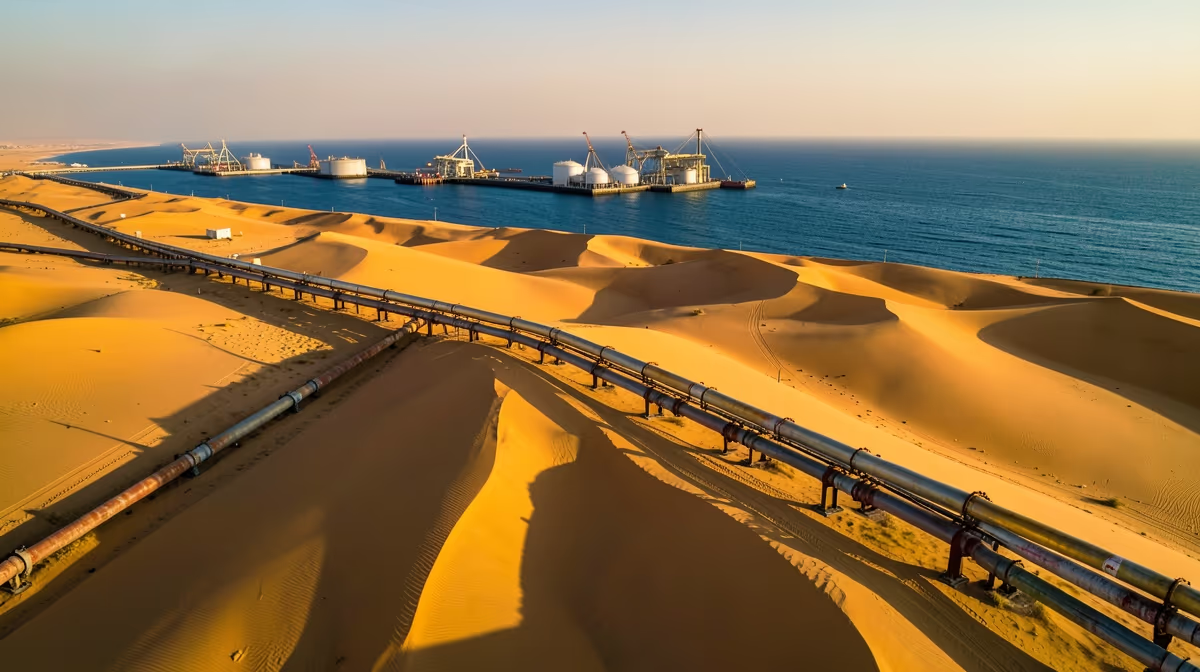
Facing persistent geopolitical tensions and threats of closure in the Strait of Hormuz, Gulf Arab nations have accelerated the construction and utilization of critical bypass infrastructure, including strategic oil pipelines designed to secure global energy supplies through alternative export routes. As geopolitical tensions rise, the development of critical gulf states hormuz bypass infrastructure has become a top priority for major Middle Eastern energy exporters seeking to protect international commerce. This strategic vulnerability arises from an over-reliance on a single maritime chokepoint, through which a significant portion of global energy supplies transit, exposing Gulf monarchies to potential coercion and military blockades.
Historical Context And Strategic Vulnerability
For decades, the Strait of Hormuz has been the primary artery for Middle Eastern oil exports. Because of recurring military tensions, threats of closure by Iran, and regional instability, Gulf states have long sought alternative ways to get their oil to the open ocean without navigating the contested strait. This pattern traces back historically to the 1980s Iran-Iraq Tanker War, which highlighted the extreme vulnerability of Gulf maritime export routes and prompted early pipeline concepts like the Kirkuk-Ceyhan and Abqaiq-Yanbu Petroline projects.
The Strait of Hormuz is a crucial maritime chokepoint situated between Oman and Iran. Roughly a fifth of the world's petroleum passes through this narrow waterway daily, making it one of the most vital shipping lanes on earth. However, this high concentration of global energy transit exposes the system to severe geopolitical flashpoints. Gulf countries like the United Arab Emirates and Saudi Arabia are working hard to build new pipelines and transport routes to mitigate these transit risks, insurance premium volatility, and potential revenue shocks by diversifying export routes, ensuring continuous hydrocarbon cash flows to fund domestic post-oil economic transformations.
Operationalizing Alternative Export Routes
In response to these enduring security risks, key producers have invested heavily in overland transit networks to bypass the maritime passage entirely. The Habshan-Fujairah oil pipeline in the UAE and Saudi Arabia's East-West Pipeline allow millions of barrels of crude to reach open waters in the Gulf of Oman and the Red Sea without navigating the contested strait. The UAE operates the Habshan-Fujairah oil pipeline, which transports crude oil from Abu Dhabi onshore oilfields directly to the port of Fujairah, bypassing the Strait of Hormuz by terminating on the Gulf of Oman. Meanwhile, Saudi Arabia's East-West Pipeline, also known as Petroline, connects eastern oil fields directly to Red Sea export terminals at Yanbu with a substantial capacity of around 5 million to 7 million barrels of oil per day.
Recent escalations in the Middle East have underscored the urgency of these infrastructure projects. Energy analysts note that while these bypass pipelines provide a crucial psychological and logistical buffer for international markets, their current capacity is still insufficient to fully replace the massive volumes typically transported via supertankers through Hormuz. Consequently, regional governments are actively exploring capacity expansions and additional overland corridors extending toward alternative ports. Beyond oil transit, regional planners are also contemplating multi-modal transport networks, including planned rail links across the Arabian Peninsula, to secure supply chains for refined products and non-petroleum goods. These infrastructure developments reflect a broader strategic shift among Gulf Cooperation Council members to diversify export routes, mitigate maritime security risks, and reassure international energy consumers.
Geopolitical And Economic Implications
Shifting regional influence drives much of this development, where the UAE and Saudi Arabia seek to project sovereignty and reduce vulnerability to Tehran's leverage, altering regional deterrence equations without direct military escalation. At the same time, a hidden angle persists in the form of intense intra-GCC competition for pipeline endpoints and terminal control, revealing underlying rivalries between the UAE and Saudi Arabia over regional logistics dominance and port access in Oman and the Arabian Sea. Redrawing global energy transit maps decreases Western strategic dependence on securing the Gulf waters and indirectly shifts naval power projection dynamics in the broader Indo-Pacific and Middle Eastern theaters.
Global energy security relies on redundant infrastructure. The expansion of bypass pipelines is no longer just a strategic contingency; it is a fundamental pillar of modern Gulf energy economics, according to Dr. Karen Young, a senior research scholar at Columbia University's Center on Global Energy Policy. When global oil supply routes are vulnerable, energy prices spike, leading to inflation and higher costs for consumers everywhere. Securing bypass infrastructure helps stabilize global oil markets, prevents sudden energy shortages, and lowers the risk of catastrophic economic shocks during political standoffs in the Middle East. Those affected by these vulnerabilities include global energy consumers, international shipping companies, major oil-importing nations in Asia and Europe, and the economies of the Gulf states themselves.
Near Term Outlook And Risk Assessment
In the immediate next twenty-four hours, observers note increased monitoring of key bypass pipeline corridors in the UAE and Saudi Arabia amid ongoing regional tensions. Looking toward the next seventy-two hours, expectations point to accelerated diplomatic talks regarding securing alternative export routes away from the Strait of Hormuz. Key players driving these developments include Saudi Aramco, ADNOC, and the Oman Ministry of Energy, all of which navigate complex intersections across energy markets, Middle East shipping, and global crude supply. Expert predictions indicate that Gulf states will continue to quietly expand overland pipeline capacity to mitigate chokepoint vulnerabilities, though complete bypass remains financially unfeasible. In a best-case scenario, smooth operational scaling of the Habshan-Fujairah and East-West pipelines successfully reassures oil markets. Conversely, the worst-case scenario involves physical sabotage or cyberattacks on bypass infrastructure coinciding with a Hormuz closure, causing historic energy spikes.
Frequently Asked Questions
What is the Strait of Hormuz bypass infrastructure?
The Strait of Hormuz bypass infrastructure consists of a network of pipelines and alternative transport routes designed to transport Gulf oil and gas without navigating the politically volatile chokepoint. These projects aim to secure global energy supplies against potential blockades or regional conflicts. Key nations like Saudi Arabia and the UAE have spearheaded these developments.
Why are Gulf states building pipelines to bypass the Strait of Hormuz?
Gulf states are developing bypass routes primarily to mitigate geopolitical risks and reduce their economic vulnerability to maritime disruptions. Because a significant portion of the world's petroleum passes through this narrow strait, any closure threatens global energy security. Alternative pipelines provide a reliable fail-safe for exporting crude directly to open oceans.
What is the Habshan-Fujairah oil pipeline?
The Habshan-Fujairah oil pipeline is a strategic Emirati project that transports crude oil from Abu Dhabi's onshore oilfields directly to the port of Fujairah on the Gulf of Oman. This infrastructure allows the UAE to export its oil while completely bypassing the Strait of Hormuz. It significantly enhances the country's energy export security and operational flexibility.
What is the capacity of the East-West Pipeline in Saudi Arabia?
Saudi Arabia's East-West Pipeline, also known as Petroline, has a substantial capacity of around 5 million to 7 million barrels of oil per day. It spans across the kingdom from Abqaiq in the east to Yanbu on the Red Sea coast. This vital artery allows Saudi oil to reach European and North American markets without transiting the Persian Gulf.
How does the UAE bypass the Strait of Hormuz for oil exports?
The UAE bypasses the Strait of Hormuz primarily through the Habshan-Fujairah oil pipeline, which terminates at the Port of Fujairah outside the Persian Gulf. Additionally, the planned Etihad Rail network and planned regional export terminals further diversify their transport logistics. These measures ensure continuous petroleum flow even during heightened regional tensions.
Are there new Gulf bypass projects planned for the future?
Regional governments continue to evaluate and expand their pipeline networks, storage facilities, and overland transport options to further insulate their economies. Discussions often involve expanding existing pipeline capacities and exploring new maritime export terminals along the Arabian Sea and Red Sea coasts. These ongoing investments highlight the enduring priority of securing energy transit routes.
Conclusion
Gulf nations possess operational pipeline infrastructure capable of diverting a portion of their daily crude oil exports away from the Strait of Hormuz, successfully mitigating exposure to regional maritime blockades. Ongoing technical assessments and potential capital allocations continue to drive the expansion of pipeline throughput capacities and the integration of trans-peninsular freight and energy networks. As regional tensions persist, governments across the region are expected to maintain active security monitoring and diplomatic engagements to safeguard these vital alternative export corridors.


.webp)

