
Meteor Shower August 12 Brings Rare Cosmic Display Across the US
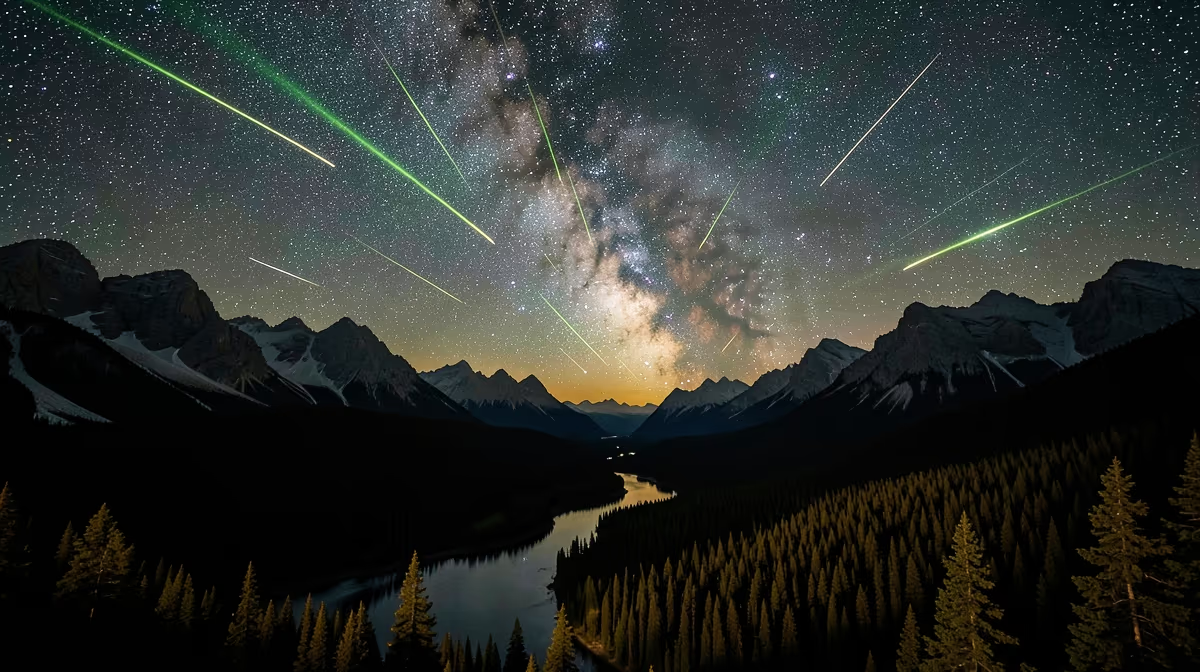
Stargazers across the United States are preparing for the peak of the annual Perseid meteor shower late into the night of August 12 and the early hours of August 13, offering skywatchers an opportunity to view up to 100 shooting stars per hour under favorable conditions. As Earth enters a dense trail of cosmic debris, millions of observers are turning their attention upward for a celestial event that combines ancient historical wonder with modern astronomical predictability.
Celestial Mechanics and the Comet Swift-Tuttle
The Perseids are widely considered one of the most reliable and prolific meteor showers of the year. Caused by Earth passing through the debris trail left behind by Comet Swift-Tuttle, the event brings pea-sized particles into our upper atmosphere at speeds of roughly 37 miles per second, where they vaporize and create bright streaks of light. The Perseids have been observed for at least 2,000 years, with some of the earliest historical records coming from ancient Chinese, Korean, and Japanese astronomers. The shower is associated with Comet Swift-Tuttle, which orbits the sun every 133 years and litters its path with tiny rocky particles that burn up in Earth's atmosphere. According to NASA meteor expert Bill Cooke, the Perseids are the campfire stories of the night sky, dependable, bright, and putting on a reliable show year after year.
Optimal Viewing Guidelines and Practical Tips
Astronomers advise viewers in the US to escape urban light pollution and head to dark-sky locations, rural areas, or state parks to maximize visibility. While the peak occurs overnight on August 12, meteor activity will remain elevated for several nights surrounding the peak. To catch the best view, you do not need any special equipment like telescopes or binoculars. Just find a dark spot away from bright city lights, look up toward the northeast after midnight, and give your eyes about 20 minutes to adjust to the dark. The best viewing time is typically between midnight and dawn. During this window, your location on Earth is turned directly into the stream of debris, yielding the highest rates of meteors. Under optimal dark-sky conditions, stargazers can expect to see between 50 and 100 meteors per hour. The Perseids are also famous for producing bright fireballs that leave glowing trails across the sky. You should look toward the northeast, specifically near the constellation Perseus, which is the radiant point of the shower. However, meteors will streak across all parts of the night sky, so you do not need to stare directly at the radiant. No special equipment like telescopes or binoculars is required to enjoy the Perseids. In fact, using them can actually limit your field of vision, as your naked eyes are the best tool for taking in the wide-open night sky. To get the best view, travel away from city lights to a dark location and give your eyes about 20 to 30 minutes to adjust to the dark, while bringing a comfortable lawn chair or blanket so you can recline and comfortably scan the entire sky.
Weather Conditions and Regional Forecasts
Weather forecasts across much of the continental US indicate generally clear skies for viewing, though localized cloud cover may obscure the spectacle in parts of the Pacific Northwest and the Gulf Coast. Clear skies in the Western US will yield optimal viewing conditions, while cloud cover in parts of the Midwest and Northeast may dampen local visibility. Localized weather patterns and cloud cover forecasts continue to update hourly across different regions of the United States, which may impact viewing potential for specific local areas. In a best-case scenario, pristine weather conditions nationwide allow millions of Americans to witness a high-rate Perseid peak, inspiring a surge in public interest for space science. Conversely, in a worst-case scenario, severe weather systems and heavy cloud cover obscure the night sky across major population centers, leading to widespread public disappointment.
Socioeconomic and Institutional Dimensions
The intersection of peak Perseid meteor shower visibility with heightened public reliance on satellite-based communication networks and amateur astronomy tourism creates a multifaceted ripple effect across society. Federal and state jurisdictions leverage public stargazing events to promote domestic space agency achievements and secure bipartisan funding for aerospace infrastructure. Economically, the event triggers a significant localized boom in rural tourism, camping equipment sales, and astrophotography gear, juxtaposed with the hidden costs of light pollution mitigation policies. Simultaneously, heightened sensitivity around orbital debris tracking and satellite constellation visibility highlights the militarization and commercial crowding of Low Earth Orbit. Furthermore, local infrastructure in remote rural counties often faces strain from sudden influxes of astro-tourists seeking dark-sky locations, echoing historical parallels like the 1972 Great Daylight Fireball, which similarly galvanized public interest in near-Earth phenomena during a period of intense geopolitical space rivalry.
Timeline of Events and Community Engagement
The progression of the event follows a structured timeline. In late initial public awareness campaigns and astronomical forecasts are published. Between August 10 and August 11, rural hotels sell out, and dark-sky parks implement overflow parking and traffic controls. On August 12 and August 13, peak viewing occurs, coinciding with social media viral surges and debates over satellite interference. Key players guiding this period include the NASA Meteoroid Environment Office, the American Meteor Society, the National Park Service, and the stargazing public. Impact areas center heavily on dark-sky parks and rural tourism, the amateur astronomy community, and social media platforms. Within the next 24 hours, peak viewing of the Perseid meteor shower will bring widespread stargazing interest, social media engagement, and localized traffic to dark-sky parks across the US. Following that window, within the next 72 hours, interest will rapidly decline as the meteor shower tapers off, replaced by mainstream media wrap-ups and stunning photography galleries.
Frequently Asked Questions
What meteor shower peaks around August 12?
The Perseid meteor shower peaks every year around August 12. It is widely considered one of the best and most reliable meteor showers to observe in the night sky.
What time is best to watch the August 12 meteor shower?
The best time to watch the Perseids is during the pre-dawn hours, typically between midnight and dawn. During this window, your location on Earth is turned directly into the stream of debris, yielding the highest rates of meteors.
How many meteors can I see on August 12?
Under optimal dark-sky conditions, stargazers can expect to see between 50 and 100 meteors per hour. The Perseids are also famous for producing bright fireballs that leave glowing trails across the sky.
Where should I look in the sky to see the August 12 meteor shower?
You should look toward the northeast, specifically near the constellation Perseus, which is the radiant point of the shower. However, meteors will streak across all parts of the night sky, so you do not need to stare directly at the radiant.
Do I need special equipment to see the August 12 meteor shower?
No special equipment like telescopes or binoculars is required to enjoy the Perseids. In fact, using them can actually limit your field of vision; your naked eyes are the best tool for taking in the wide-open night sky.
How can I improve my view of the August 12 meteor shower?
To get the best view, travel away from city lights to a dark location and give your eyes about 20 to 30 minutes to adjust to the dark. Bring a comfortable lawn chair or blanket so you can recline and comfortably scan the entire sky.
Conclusion
The peak of the Perseid meteor shower provides a reliable, accessible celestial event for millions of observers across the United States. With confirmed astronomical mechanics driven by Comet Swift-Tuttle, clear observational timelines, and localized weather dependencies, the event highlights the intersection of public science engagement and outdoor recreation. As peak viewing concludes over the coming days, interest will transition toward media documentation and scientific wrap-ups, while communities return to standard operations following the influx of stargazing visitors.


