
Total Solar Eclipses Reveal Rare Celestial Alignment Dynamics
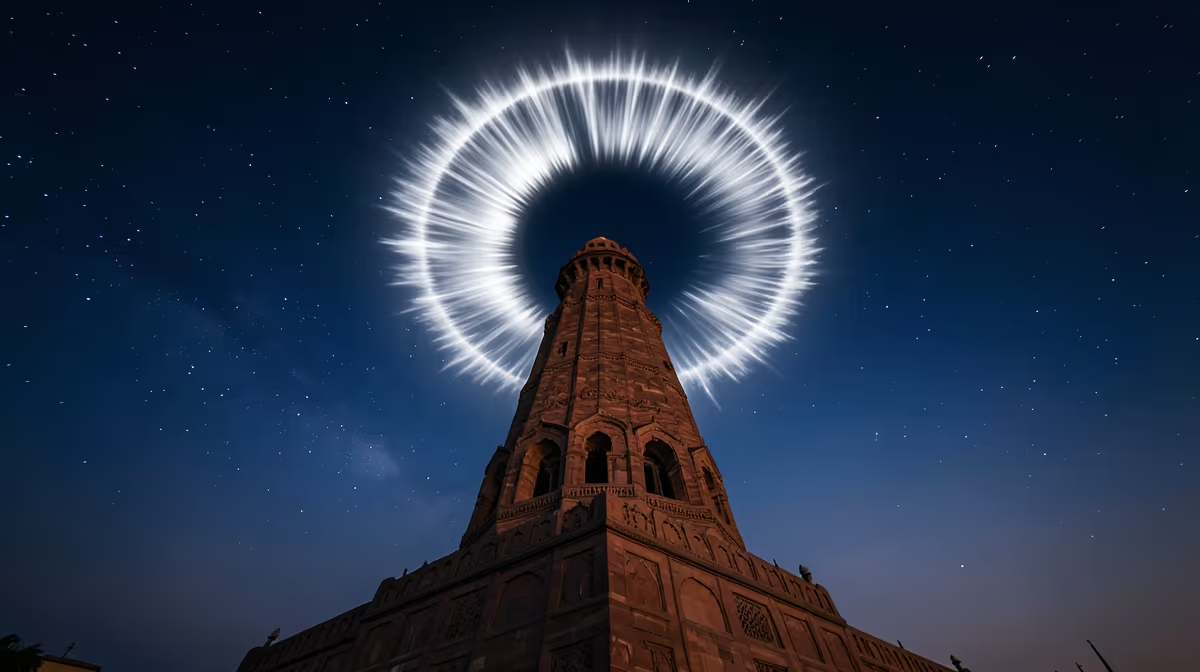
Astronomy enthusiasts across India are preparing for future celestial alignments, though the next total solar eclipse visible from the Indian mainland will not occur until the latter half of the 21st century, according to astronomical projections. When the Moon passes directly between the Earth and the Sun, it completely blocks the Sun's light for a brief moment, producing total solar eclipses that captivate observers globally. People across different regions occasionally get to witness this incredible celestial event, depending on the shadow's path. During totality, day turns into a sudden twilight, the stars and planets become visible in the sky, and the Sun's glowing outer atmosphere, called the corona, shines like a halo around the dark Moon. For a few minutes, the temperature drops and nature gets quiet as animals and birds react as if night is falling. It is a completely safe event to look at, but only during the exact moments of totality when the Sun is 100% blocked. At all other times, looking at the Sun requires special solar viewing glasses to prevent permanent eye damage.
Historical Fascination and Modern Science
While partial solar eclipses are frequently observed from the subcontinent, total solar eclipses where the moon completely obscures the sun's disk are rare regional events. The most recent total solar eclipses visible from parts of India occurred in 1995, 1999, and 2009, drawing millions of spectators and researchers to the paths of totality. Throughout history, total solar eclipses have sparked fear, awe, and scientific discovery. Ancient cultures often viewed them as omens or mythological events, while modern astronomers have used eclipses to make groundbreaking discoveries, such as proving Einstein's theory of general relativity in 1919. The Vedic era codification of Rahu and Ketu mythology surrounding solar devouring laid the foundation for deep-seated cultural mythologies regarding celestial omens. This historical backdrop contrasted sharply with the 1995 pan-Indian scientific awareness campaigns and grassroots rationalist movements, and now shapes how the digital-era public engages with celestial phenomena.
Current Research and Public Engagement
During major celestial alignments, scientific institutions such as the Indian Space Research Organisation, the Astronomical Society of India, the M. P. Birla Planetarium, and the National Science Centre mobilize public outreach programs and scientific observation campaigns. These initiatives aim to educate the public about eye safety and harness data regarding the solar corona during the brief moments of darkness. Astronomical societies continue to emphasize public safety protocols, reminding citizens never to view the sun directly without certified solar filters. Educational workshops are routinely organized ahead of any partial solar events to prevent retinal damage and dispel traditional myths associated with celestial alignments. In the next 24 hours, no immediate total solar eclipses are scheduled for India, meaning astronomical monitoring and planetarium discussions will focus on upcoming global celestial events and educational outreach. Furthermore, astronomical societies in India will continue public engagement programs over the next 72 hours, sharing data on future visibility paths and safety protocols for solar observation.
Economic and Societal Dimensions
The cultural and scientific weight of these events carries distinct socioeconomic ripples. The root cause of public mobilization remains the celestial mechanics driving lunar shadow intersections across the Indian subcontinent, amplified by deep-seated cultural mythologies regarding celestial omens. Economically, major alignments often spark a surge in astro-tourism revenues and hospitality sector spikes along the totality path, though this can be contrasted with industrial productivity losses due to widespread closures during peak hours. Political regimes occasionally utilize astronomical events to either project scientific modernization or pander to religious constituencies through ritualistic patronage. Simultaneously, a hidden angle emerges in the exploitation of superstitious anxieties by commercial entities peddling unverified protective gear, ritual cleansings, and astrological consultations. On the diplomatic front, space diplomacy and collaborative scientific data sharing between the Indian Space Research Organisation and international space agencies remain active during solar corona observations.
Safety Protocols and Scientific Significance
Total solar eclipses provide scientists with a rare opportunity to study the Sun's corona, which is normally hidden by the intense glare of the solar surface. A total solar eclipse occurs when the Moon completely covers the Sun's disk, allowing the corona or the Sun's outer atmosphere to become visible to the naked eye during totality. Because the path of totality is narrow, only specific geographic locations experience the full eclipse. Looking directly at the Sun without certified eye protection outside of totality can cause severe eye damage, and animals often become confused by the sudden darkness, mistaking it for nighttime. For the general public, it is a moment of shared wonder that brings communities together, inspires interest in science and space exploration, and offers a breathtaking reminder of our place in the universe. People living in or traveling to the specific path of totality experience the full eclipse, while millions more across the wider region get to see a partial solar eclipse, heavily impacting local tourism, transport systems, and schools as people gather to watch the event.
Outlook and Expert Predictions
Interest in total solar eclipses in India remains high following global events, driving increased participation in amateur astronomy and educational tourism ahead of the next visible eclipse in the region. Experts predict that in the best-case scenario, widespread educational campaigns will successfully promote safe viewing habits and inspire a new generation of students to pursue STEM fields through public stargazing events. Conversely, the worst-case scenario points to a lack of immediate local visibility leading to diminished public engagement, while isolated instances of unsafe viewing practices prompt health warnings from medical authorities. Local science clubs and tourism boards are currently developing specialized astro-tourism packages for upcoming annular and partial solar eclipses visible in neighboring regions, ensuring that public interest remains channeled into constructive scientific inquiry.
Frequently Asked Questions
When is the next total solar eclipse visible in India?
The next total solar eclipse visible from India will occur on March 20, 2034. However, its visibility path will be limited to certain northern regions of the country at sunrise. Astronomy enthusiasts across India are already preparing to witness this rare celestial event.
Can I watch a total solar eclipse with my naked eyes in India?
No, it is unsafe to view a total solar eclipse with the naked eye during the partial phases, as it can cause permanent eye damage. You must use certified solar viewing glasses or indirect projection methods. The only time it is safe to remove eye protection is during totality, and even then, only for a brief moment.
What happens during a total solar eclipse?
During a total solar eclipse, the Moon passes directly between the Earth and the Sun, completely blocking the Sun's bright face. This causes a sudden drop in temperature, dims the sky like twilight, and reveals the Sun's faint outer atmosphere known as the corona.
Are there any total solar eclipses happening this year in India?
No, there are no total solar eclipses visible from India this year. Eclipses that occur globally are often only visible as partial eclipses or may not be visible at all from the Indian subcontinent due to geographical alignment.
Why are total solar eclipses so rare for a specific location?
Total solar eclipses are rare for any specific location on Earth because the shadow cast by the Moon is very narrow. While a total eclipse happens somewhere on Earth every 18 months or so, it recurs at any specific spot only once every 375 years on average.
What safety precautions should be taken during a solar eclipse in India?
People in India are advised to avoid looking directly at the sun without proper ISO 12312-2 compliant solar filters. Many households also follow traditional customs such as avoiding cooked food and staying indoors during the eclipse hours, though scientists emphasize that eye safety is the primary concern.
Conclusion
Astronomical data and historical records confirm that total solar eclipses remain among the most scientifically valuable and visually striking phenomena observable from Earth. While mainland India awaits its next major totality event in the coming decades, ongoing educational outreach by scientific institutions continues to foster public awareness and safe observation practices. Realistic next steps involve sustained collaboration between astronomical societies, educational bodies, and local authorities to promote scientific literacy and ensure public safety during all future celestial alignments.


