
Supreme Court Size Limit Amendment Fails in US House Vote
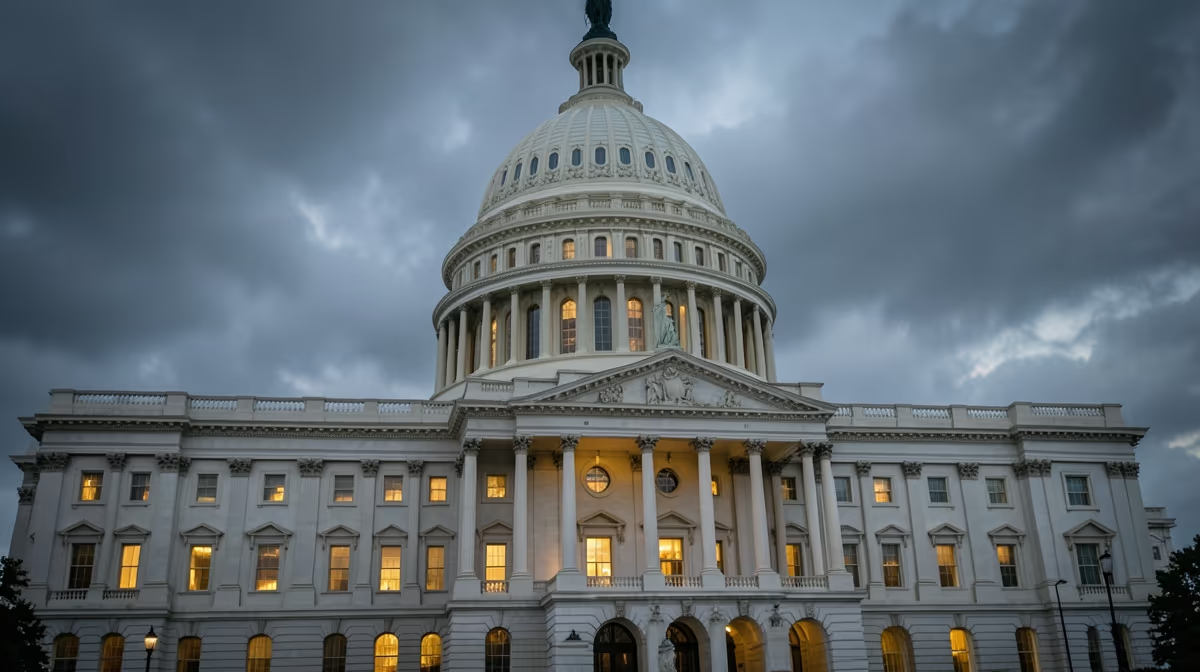
The US House recently voted down a contentious constitutional amendment aimed at cementing the Supreme Court 9 justices limit. The U.S. House of Representatives has rejected a Republican constitutional amendment that sought to permanently limit the Supreme Court to nine justices, according to reports from CBS News and Yahoo.
Legislative Background and the GOP Proposal
Intensifying partisan conflict over the composition and judicial philosophy of the United States Supreme Court prompted Republican lawmakers to pursue a constitutional amendment to permanently lock in the current nine-justice structure and safeguard the conservative majority against future court-packing initiatives. Proponents of the measure argued that setting the number in stone would prevent future political efforts to expand the court. The legislative effort aimed to cement the current size of the Supreme Court and prevent future expansions or changes to its composition.
While maintaining nine justices has been a long-standing norm, the idea of altering that number has periodically emerged during intense partisan debates. The size of the U.S. Supreme Court has changed several times throughout American history by acts of Congress, ranging from six justices initially up to ten, before settling at nine in 1869.
The Political Fallout in the US House
Democrats and other opponents successfully sank the bid, keeping the door open for future debates regarding the structure and size of the nation's highest judicial body. While the proposed constitutional amendment failed to secure the necessary backing in the House, discussions surrounding the future and makeup of the Supreme Court remain a prominent flashpoint in American politics.
The failed Republican bid highlights deep legislative polarization in the House, where Democrats successfully blocked an effort designed to cement the conservative majority. This underscores how institutional design of the judiciary has become a central proxy war in broader partisan struggles over federal power.
Broader Context and Docket Pressures
Separately, the Supreme Court has also faced other legal questions this week, including petitions concerning prediction markets from states like New Jersey, though the primary focus on Capitol Hill centered squarely on the legislative fight over the court's size. The intense focus on court size may serve to deflect legislative attention from emerging technology, financial, and digital asset regulations—such as prediction markets—that are increasingly crowding the Court's docket and require proactive statutory frameworks rather than judicial intervention.
Historical Parallels and Economic Dimensions
Franklin D. Roosevelt's Judicial Procedures Reform Bill of 1937, commonly known as the court-packing plan, similarly sought to alter the size of the Supreme Court to shift its ideological balance but ultimately failed amid bipartisan pushback. While structural changes to the Supreme Court do not carry immediate fiscal costs, prolonged uncertainty regarding judicial stability and regulatory oversight can influence long-term corporate governance, sector-specific compliance costs, and broader market confidence in federal arbitration. As the supreme judicial arbiter of the world's largest economy, domestic stability and perceived institutional legitimacy of the U.S. Supreme Court indirectly affect international investor confidence and the global predictability of U.S. regulatory and trade policy enforcement.
Future Outlook and Expert Analysis
Analysts would likely expect the failed amendment to fuel ongoing partisan debates over court reform and judicial expansion heading into future legislative sessions. Over the next 24 hours, continued political and media discussion is expected to surround the House's rejection of the GOP constitutional amendment to limit the Supreme Court to nine justices. In the next 72 hours, further debate and party-line messaging regarding the size, composition, and future security of the U.S. Supreme Court's conservative majority will likely take center stage.
Depending on legislative paths chosen, the best-case scenario is that the vote serves to close a contentious chapter on court size modification, allowing Congress to pivot toward bipartisan judicial oversight or administrative reforms. Conversely, the worst-case scenario entails the failed measure hardening partisan divides over the judiciary, increasing the likelihood of escalating political friction surrounding future court appointments and structural reforms.
Frequently Asked Questions
Why did the House reject the GOP constitutional amendment?
Democrats sank the Republican bid to cement the US Supreme Court's conservative majority by limiting the court to nine justices. The proposed constitutional amendment failed to secure the necessary support in the House.
What was the purpose of the Republican constitutional amendment?
The GOP-backed constitutional amendment aimed to permanently lock the number of Supreme Court justices at nine. Republicans sought this measure to prevent any future expansion or court-packing by political opponents.
What happens next following the House vote?
With the House rejecting the measure, the debate over the size of the Supreme Court remains unresolved. Lawmakers on both sides of the aisle will likely continue sparring over the structure and political balance of the nation's highest court.
Who is affected by the Supreme Court size debate?
The entire US legal system, lawmakers, and the American public are affected by discussions surrounding the Supreme Court's composition. Changes to the number of justices could drastically alter ideological rulings and the interpretation of federal law.
What is the background of the debate over Supreme Court justices?
The size of the Supreme Court has historically fluctuated by statute rather than constitutional amendment before being set at nine in the 19th century. Recent political polarization has revived intense debates about whether to expand or permanently fix the bench's size.
When did the House vote on the Supreme Court amendment?
The House voted on the Republican constitutional amendment addressing the number of Supreme Court justices in early September 2026. Major news outlets like CBS News and Yahoo covered the defeat of the GOP bid.
Conclusion
The U.S. House of Representatives has officially rejected the Republican constitutional amendment aiming to permanently limit the Supreme Court to nine justices, with Democrats successfully sinking the bid to lock in the conservative majority. While confirmed developments center on the failed legislative measure and ongoing party-line divisions in Congress, lawmakers, legal scholars, and the public continue to navigate broader questions regarding the nation's judicial structure. As discussions and media coverage persist around the future makeup and stability of the Supreme Court, further legislative and political maneuvering remains expected in upcoming sessions.
Sources
- House rejects GOP constitutional amendment to limit Supreme Court to 9 justices — CBS News
- Democrats sink Republican bid to cement US Supreme Court's conservative majority — Yahoo
- House to vote on number of justices — SCOTUSblog
- First challenge to prediction markets reaches Supreme Court — CNN
- New Jersey asks the Supreme Court to take on prediction markets — CNBC
- Are Sports Prediction Markets Legal? The Supreme Court Is Asked to Weigh In. — Barron's


