
Saudi Airport Attack Triggers High Alert Across Key Regional Corridors
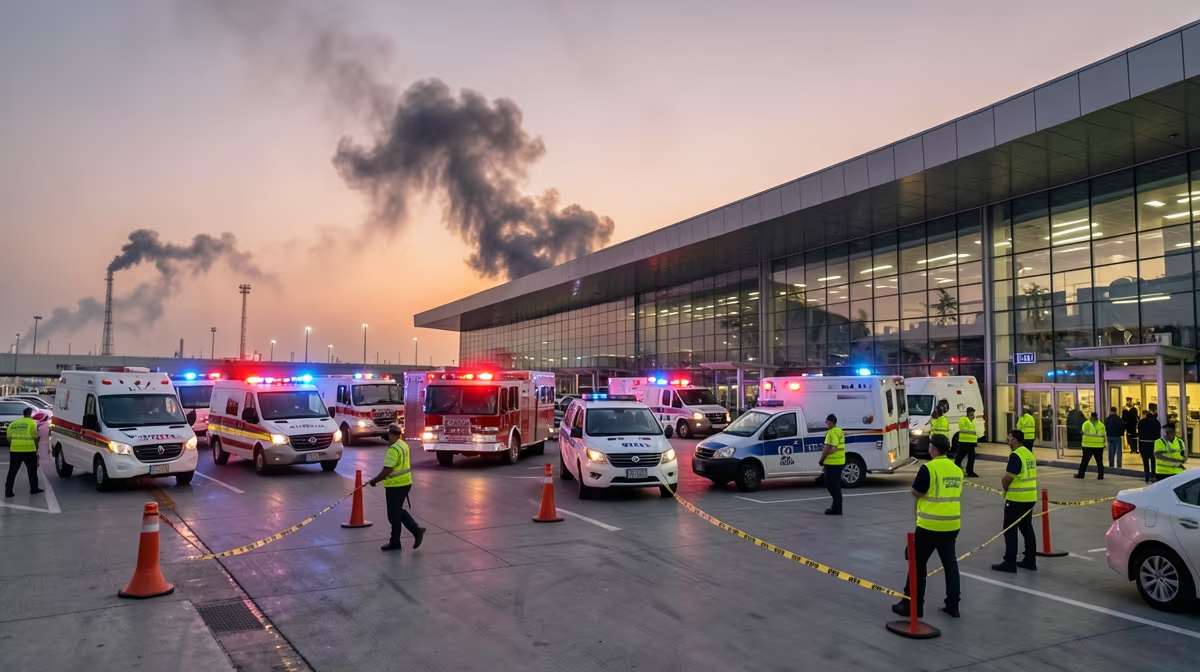
Commercial air corridors and sovereign energy facilities represent the foundational pillars of regional stability across the Gulf, yet an unexpected assault on civilian transit has disrupted standard security assumptions. The deadly Saudi airport attack has left one person dead, eight others injured, and regional transport networks confronting urgent operational adjustments. As emergency responders secured the perimeter and coordinated medical evacuations, incoming flights were diverted away from the Eastern Province to protect civilian air traffic from further hazard.
The fatal strike on King Fahd International Airport alongside an attack on the Shaybah oilfield underscores an escalating threat to commercial aviation and vital energy hubs.
The incident has triggered rapid emergency protocols across civil aviation authorities and regional defense commands. With commercial hubs and energy sites simultaneously confronted by security risks, the event highlights how quickly disruptions at civilian transport nodes can reverberate across international supply chains and travel corridors.
Coordinated Strikes on Critical Infrastructure
The assault on King Fahd International Airport, also widely known as Dammam airport, did not occur in complete isolation. As civil aviation officials worked to address the casualties and divert scheduled aircraft in Dammam, reports emerged detailing a concurrent security incident targeting the Shaybah oilfield, situated deep in the Empty Quarter.
The geographical spread between Dammam in the Eastern Province and the remote desert expanse of Shaybah demonstrates the multi-vector scope of the challenge facing security forces. While King Fahd International Airport functions as a primary commercial conduit connecting the Eastern Province to major global destinations, Shaybah represents a vital component of the kingdom's petroleum extraction and production network.
| Site | Location | Nature of Incident | Reported Impact |
|---|---|---|---|
| King Fahd International Airport | Dammam, Eastern Province | Infrastructure strike and explosion | One killed, eight injured, flights diverted |
| Shaybah Oilfield | Empty Quarter | Infrastructure strike | At least one Indian national injured |
The simultaneous or closely timed reporting of these strikes suggests a calculated operational dynamic. Rather than delivering an isolated blow to a single perimeter, the concurrent incidents indicate a deliberate effort to divide defensive focus across geographically disparate transport and resource installations.
Casualties and the Immediate Emergency Response
The physical toll at Dammam airport materialized rapidly as emergency crews mobilized across the facility. News agencies including Al Jazeera, Firstpost, ANI News, and India Today confirmed that one individual was killed and eight others suffered injuries during the attack.
- Medical responders initiated triage operations immediately on site, providing emergency stabilization to the wounded before organizing hospital transport.
- Security personnel and local authorities established an active safety cordon across the airport grounds to isolate blast damage and screen for secondary hazards.
- Civil aviation teams at Dammam initiated crisis management protocols to safeguard remaining ground staff, airport personnel, and travelers.
- At the Shaybah oilfield, emergency medical units responded to infrastructure damage where at least one Indian national was confirmed among the injured.
The physical injuries suffered by local and foreign personnel highlight the direct human cost borne by workers who operate the Gulf's international transport and industrial hubs. Families of the casualties, airport staff, and multinational workforces across both facilities have been placed at the center of the unfolding aftermath.
Operational Disruption and Aviation Fallout
Aviation safety depends on predictable airspace management, and any kinetic penetration of airport airspace necessitates immediate defensive measures. When explosions and security breaches were confirmed at King Fahd International Airport, air traffic controllers moved swiftly to reroute airborne flights away from Dammam.
Persistent regional security vulnerabilities and the targeting of commercial and energy nodes directly imperil air traffic safety and international supply chain stability.
Inbound airliners were held, rerouted to alternative airfields, or turned back to originating points to prevent civilian aircraft from entering an active emergency zone. Ground operations were temporarily suspended as technical teams conducted runway sweeps and structural inspections to assess the scope of damage to airport installations.
The operational diversions produced immediate knock-on effects across domestic and international flight schedules. Passengers scheduled to depart or arrive in Dammam faced major delays, cancellations, and gate reassignments while regional aviation authorities coordinated with airline operators to safely manage airspace capacity.
Strategic Probing and Regional Security Architecture
Beyond the immediate tactical emergency, analysts observing Middle East conflict dynamics interpret the strike as a test of defensive networks. The operational architecture protecting civil aviation and petroleum complexes relies on early-warning radar, layered interceptors, and strict ground surveillance.
A key investigative consideration centers on whether these strikes were executed as a multi-vector probing strategy. By targeting a high-profile commercial aviation hub in Dammam while simultaneously threatening deep-desert extraction assets at Shaybah, the perpetrators exposed regional monitoring systems to multiple points of pressure. Analysts note that this technique aims to evaluate radar detection limits, command reaction times, and the speed of joint defensive coordination.
Historical parallels have been drawn to the 2019 Abqaiq-Khurais oil processing facility attacks, an event that temporarily disrupted global petroleum production and demonstrated the inherent vulnerability of concentrated infrastructure. While the full extent of the structural damage at Dammam and Shaybah continues to be evaluated, the incidents renew questions regarding regional deterrence capabilities and the long-term defense of interconnected commercial nodes.
Economic Exposure and Infrastructure Vulnerability
The targeting of transport and energy infrastructure introduces substantial economic frictions into the regional marketplace. For the Eastern Province, King Fahd International Airport serves not merely as a passenger transit terminal, but as a critical logistics hub for global business, technical personnel, and commercial trade.
- Aviation risk premiums: Airlines operating in regional corridors face heightened operational costs, insurance adjustments, and mandatory safety evaluations following kinetic strikes on civilian airfields.
- Supply chain disruptions: Flight rerouting and temporary ground stops impede cargo movements, just-in-time logistics, and regional business connectivity.
- Foreign investment sentiment: Repeated targeting of municipal transport hubs and upstream petroleum assets tests commercial confidence among multinational partners and foreign enterprises.
- Energy security reassessments: Concurrent threats against remote extraction facilities like Shaybah draw intense scrutiny toward the physical security of critical global energy supply lines.
Saudi leadership faces mounting pressure to demonstrate absolute airspace control and robust defensive deterrence. Reassuring international partners, protecting foreign workers, and maintaining stable commercial operations remain paramount to insulating national economic initiatives from persistent regional instability.
Operational Outlook: Scenarios for the Next 72 Hours
The trajectory of the recovery effort across Saudi Arabia's Eastern Province depends on official security reviews, structural assessments, and airspace evaluations. Over the next 24 hours, aviation authorities and regional security forces are expected to secure King Fahd International Airport, complete damage surveys, clear affected operational areas, and systematically resume diverted flight schedules.
Over the next 72 hours, defensive measures across both transit corridors and energy hubs will remain on elevated alert. Government officials and aviation authorities are expected to release formal statements clarifying the origin of the strikes, the weapons utilized, and the status of wounded personnel.
Potential Recovery Scenarios
- Best-case scenario: Operations at King Fahd International Airport resume rapidly with minimal ongoing flight disruptions, while security forces fully stabilize the perimeter and prevent secondary incidents.
- Worst-case scenario: Protracted operational suspensions, renewed logistical bottlenecks, heightened regional security anxieties, and persistent threats across sensitive transport and petroleum facilities.
Aviation and defense analysts project that heightened safety protocols will persist across regional airports, ensuring that infrastructure monitoring remains at maximum vigilance while investigations continue.
Frequently Asked Questions
What happened during the attack in Saudi Arabia?
An attack targeted King Fahd International Airport in Dammam, Saudi Arabia, resulting in the tragic death of one person and injuries to eight others. Flights were subsequently diverted as authorities responded to the security incident.
Why does the Saudi airport attack matter?
This incident raises significant concerns regarding aviation safety and regional security infrastructure in Saudi Arabia. Targeting major transport hubs directly impacts international travel, trade, and economic stability in the area.
Who was affected by the Saudi airport attack?
Passengers, airport staff, and local authorities were directly impacted by the security breach and subsequent casualties. Additionally, travelers experienced disruptions as flights were diverted away from the targeted facility.
What happens next following the airport strike?
Security forces and aviation authorities are expected to conduct thorough investigations while bolstering safety protocols at airports across the region. Normal flight operations will resume incrementally as the affected facilities are fully secured.
What is the background of King Fahd International Airport?
King Fahd International Airport, located in Dammam, serves as a major aviation hub in Saudi Arabia's Eastern Province. It plays a crucial role in connecting the region to international destinations.
Were any other locations targeted alongside the airport?
Reports also indicated an incident involving an Indian national injured in a separate attack at the Shaybah oilfield in Saudi Arabia. Authorities are reviewing all related security events to ensure overall protection of critical infrastructure.
Conclusion
The fatal strike on King Fahd International Airport in Dammam marks a serious escalation in the targeting of civilian transit infrastructure. With one confirmed death, eight injured victims, and an Indian national wounded in a concurrent incident at the Shaybah oilfield, emergency services and military commands have mobilized to restore order and contain the fallout. As investigators work to determine the technical origins of the strikes, the immediate priority remains the safe resumption of commercial flights, the protection of multinational workers, and the stabilization of vital transport and energy installations across the kingdom.
Sources
- One killed, eight injured in attack on Saudi Arabia’s King Fahd airport — Al Jazeera
- Breaking News Live: One Indian injured in attack at Saudi Arabia’s Shaybah oilfield; King Fahd airport also attacked — The Economic Times
- 1 killed, 8 injured in attack on Saudi Arabia’s Dammam airport — Firstpost
- One dead, eight injured in attack on King Fahd International Airport in Saudi Arabia's Dammam — ANI News
- Saudi airport attack kills one, injures eight as flights diverted — India Today


