
Global Combat Air Programme Unlocks Next-Gen Defense Secrets
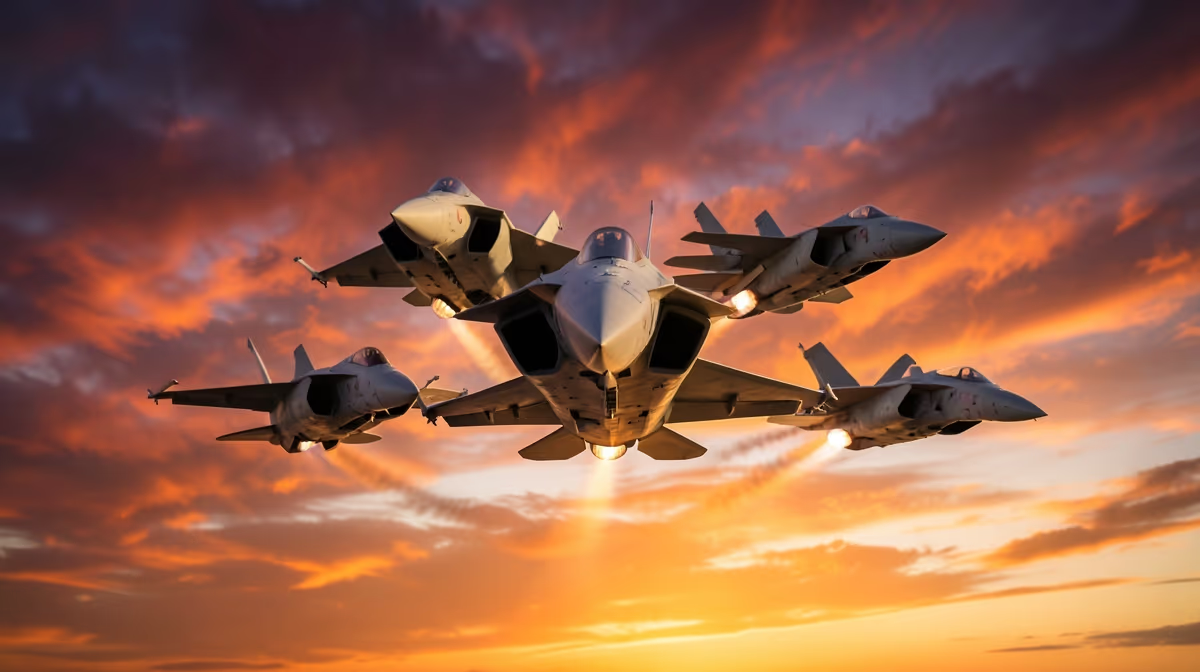
The global combat air programme continues to shape the future of defense architecture as three sovereign nations unite to redefine aerial warfare by the middle of the next decade. Behind closed doors and across parliamentary chambers, the collaborative blueprint for a revolutionary combat fleet is moving from conceptual ambition into concrete industrial reality.
Genesis Of A Trilateral Defense Pact
The root cause behind this massive collaboration lies in the prohibitive cost of next-generation stealth technology and the gradual erosion of sovereign aerospace industrial bases. Mid-tier European and Asian powers found themselves facing a stark economic reality where developing a sixth-generation fighter independently was financially unsustainable.
The timeline of this trilateral effort traces back to 2018, when the UK unveiled the Tempest concept at the Farnborough Airshow. Recognizing the immense costs and shared strategic challenges in both the Indo-Pacific and European regions, the UK ultimately joined forces with Italy and formally merged with Japan's similar next-generation fighter initiative in late 2022 to create the trilateral global combat air programme partnership. This trajectory culminated in 2024 when a formal treaty was signed establishing the joint government organization and industry framework.
This historical parallel echoes the development of the Panavia Tornado or the Eurofighter Typhoon, where multi-nation consortia balanced national prestige with the grim economic realities of escalating jet fighter costs. By pooling resources, the participating democratic nations can share the financial and engineering burden while maintaining a dominant edge in future airspace defense.
The Official Treaty And Industrial Framework
The UK, Italy, and Japan officially signed an international treaty in London on Wednesday to establish the Global Combat Air Programme, a joint venture aimed at delivering a next-generation fighter jet by 2035 to counter rising global security threats. This landmark agreement formally establishes the GCAP International Government Organisation, which will manage the multi-national development of the advanced supersonic stealth aircraft.
The headquarters for the joint venture will be located in the United Kingdom, while the first chief executive officer will be appointed from Japan and the leadership of the business consortium will be led by Italy. Major defense contractors BAE Systems representing the UK, Leonardo for Italy, and Mitsubishi Heavy Industries for Japan are spearheading the industrial manufacturing and technological integration of the platform. Engine development is spearheaded by Rolls-Royce, IHI Corporation, and Avio Aero, working alongside numerous other technology suppliers across the three nations.
The fighter jet, intended to replace the UK Royal Air Force's Typhoon and the Italian Air Force's equivalent fleets, will feature state-of-the-art radar, advanced artificial intelligence, and the capability to operate both manned and unmanned missions. Despite the formal treaty signing, significant financial and logistical hurdles remain as the partners attempt to harmonize their distinct defense procurement timelines and export policies. Government officials maintain that burden-sharing and technology transfer agreements are firmly in place to ensure the project remains on schedule for its 2035 operational target.
Geopolitical And Political Realities
Prime Minister Rishi Sunak and defense ministers leveraged the project to project post-Brexit Global Britain leadership, binding Italy and Japan into a trilateral pact that bypasses traditional EU-centric defense frameworks. Geopolitically, the initiative solidifies an inter-theater defense bridge between NATO and the Indo-Pacific, effectively acting as a technological counterweight to Chinese and Russian sixth-generation fighter programs.
Beneath the diplomatic alignment, however, lies a complex economic and industrial dynamic. Massive capital expenditure sharing offsets soaring research and development costs, while guaranteeing high-tech manufacturing jobs, tech-transfer disputes, and long-term supply chain dominance across the UK, Italy, and Japan. A high-stakes industrial espionage battle and export-control tug-of-war frequently simmers between BAE Systems, Leonardo, and Mitsubishi Heavy Industries over intellectual property rights and who controls the software architecture.
Operational Outlook And Immediate Trajectory
In the next 24 hours, routine diplomatic consultations and bureaucratic alignment between the UK, Japan, and Italy are expected regarding GCAP industrial workshare agreements. Looking slightly further ahead, the next 72 hours will likely bring continued parliamentary monitoring of defense spending commitments and supply chain integration discussions among prime contractors BAE Systems, Mitsubishi Heavy Industries, and Leonardo.
Defense analysts predict the program will maintain its current trajectory of collaborative design phases, though long-term funding pressures and export control harmonizations will remain under close scrutiny. The best-case scenario involves the successful finalization of formal joint venture agreements and an accelerated timeline for technology demonstrators, boosting investor confidence. Conversely, the worst-case scenario points to potential bureaucratic delays or disagreements over intellectual property rights and workshare distribution causing friction among partner nations.
Frequently Asked Questions
What is the Global Combat Air Programme?
The Global Combat Air Programme, or GCAP, is a trilateral multinational initiative launched by the UK, Japan, and Italy. Its primary goal is to develop a next-generation stealth fighter jet to replace current aircraft like the RAF Typhoon and Japanese F-2. The advanced combat aircraft is scheduled to enter service by the mid-2030s.
Which countries are involved in GCAP?
The core nations partnering in the Global Combat Air Programme are the United Kingdom, Japan, and Italy. These countries are pooling their technological expertise, industrial capabilities, and financial resources to build the advanced sixth-generation fighter. Other nations may potentially join or collaborate on specific technologies in the future.
When will the GCAP fighter jet enter service?
The partners in the Global Combat Air Programme are working toward an ambitious target of introducing the next-generation fighter into active service by 2035. Meeting this timeline requires rapid technological development and close cooperation among British, Japanese, and Italian aerospace industries. Initial design and concept phases are already well underway.
What companies are building the GCAP aircraft?
The major industrial partners leading the development of the gcag fighter jet are BAE Systems representing the UK, Mitsubishi Heavy Industries for Japan, and Leonardo for Italy. Additionally, engine development is spearheaded by Rolls-Royce, IHI Corporation, and Avio Aero. These defence primes work alongside numerous other technology suppliers across the three nations.
Is GCAP replacing the Tempest fighter?
Yes, the GCAP initiative essentially absorbs the UK's previous domestic Tempest project into a broader international framework. The Tempest concept serves as the technological foundation for the British contribution to the trilateral programme. It remains a sixth-generation combat aircraft project focused on advanced sensors, AI, and optional uncrewed flight.
Will the GCAP jet be piloted or uncrewed?
The GCAP aircraft is being designed as a crewed core platform with the advanced capability to operate uncrewed when required. It will feature cutting-edge technologies, including artificial intelligence, swarming drone control, and highly advanced sensor fusion. This flexibility ensures the fighter can adapt to evolving threat environments in future aerial combat scenarios.
Conclusion
The formal establishment of the trilateral treaty in London marks a definitive milestone in the evolution of modern military aviation. With the GCAP International Government Organisation now anchored in the United Kingdom, leadership roles distributed across Japan and Italy, and major defense contractors actively engaged in engineering the platform, the initiative remains anchored to its 2035 operational deployment target. As participating nations navigate ongoing discussions regarding industrial workshares, export controls, and supply chain harmonization, the success of the program will depend on sustained financial commitment and cooperative technical integration among the partner governments and industrial primes.


