
National Defense Authorization Act Moves Forward With Major Shifts Ahead
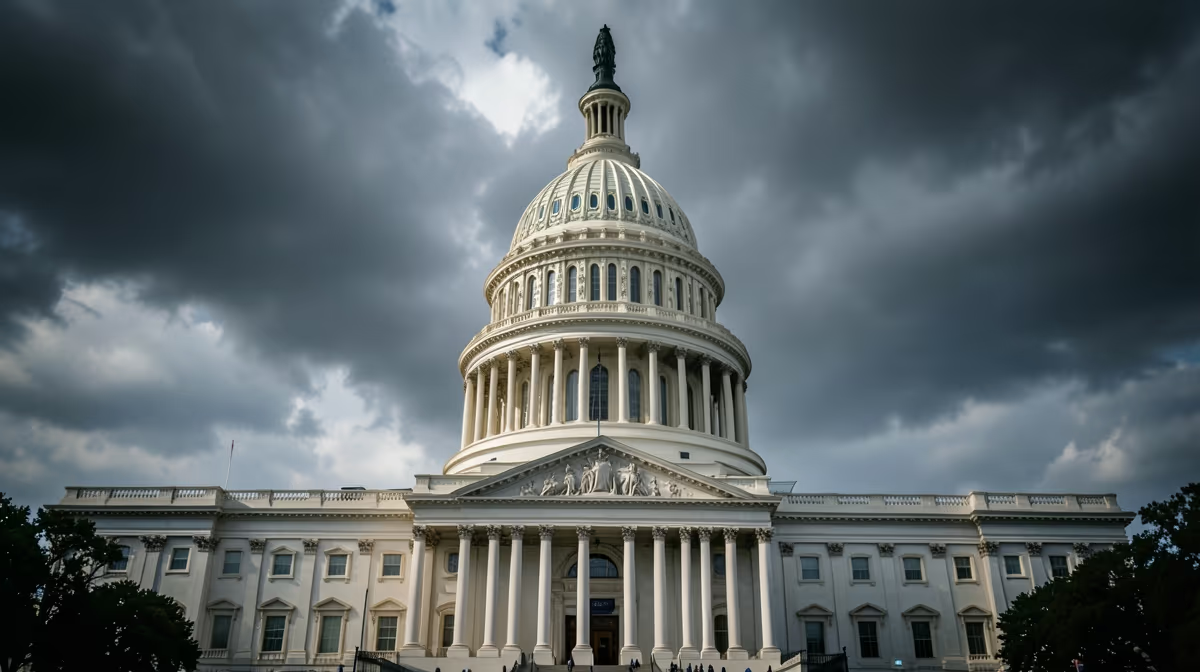
Congressional leaders reached a decisive bipartisan compromise on the annual National Defense Authorization Act late Tuesday in Washington, securing a vital $886 billion defense policy framework that authorizes crucial military readiness funding and troop pay raises amid escalating global tensions. The latest national defense authorization act has moved forward in Congress, setting the stage for major shifts in military policy and the upcoming fiscal year defense budget. This monumental legislation, negotiated over months by House and Senate leaders, outlines defense spending priorities and policy directives for the upcoming fiscal year while navigating complex political dynamics and global security demands.
Legislative Mechanics and Core Structure
The national defense authorization act, often called the NDAA, is a massive and crucial bill that Congress passes every single year. Its main job is to set the budget and establish policies for the United States military and national security agencies. Think of it as the ultimate financial roadmap and rulebook for America's armed forces, deciding everything from how much money the Pentagon gets to how the military should be run. Because the military touches almost every aspect of national security and employs millions of people, this bill always includes a wide variety of topics. Beyond just buying weapons and equipment, it frequently tackles major policy changes, such as how the military handles foreign threats, cyber security rules, and benefits for service members.
Originating from the post-World War II era, the NDAA process was established to give Congress regular oversight over the military's budget and activities, ensuring civilian control over the armed forces as mandated by the US Constitution. It is one of the few pieces of legislation that has been passed reliably every single year for over six decades. The legislation determines the total budget and spending priorities for the Department of Defense, decides pay raises and healthcare benefits for US troops and military families, and authorizes the purchase of new military equipment, technology, and weapons systems. It often includes non-defense policy riders and compromises negotiated by both political parties.
Key Provisions and Budgetary Impact
Lawmakers successfully navigated contentious social and cultural debates that had previously stalled the process, ultimately trimming several partisan amendments to ensure the bill's passage. A central component of the compromise is a 5.2% pay increase for service members, the largest raise in over two decades, aimed at addressing recruitment and retention challenges across all branches of the armed forces. Additionally, the legislation authorizes substantial investments in advanced technology, shipbuilding, and munitions stockpiles to counter strategic competitors like China and Russia.
The final text also addresses ongoing security assistance for international allies, incorporating provisions for Ukraine aid while establishing strict oversight and accountability measures for U.S. military assistance abroad. Defense committees in both chambers are scheduled to vote on the conference report later this week before sending the legislation to the President's desk for signature. This agreement reflects our shared commitment to providing our men and women in uniform with the resources they need while responsibly managing taxpayer dollars, stated House Armed Services Committee Chairman Mike Rogers in a joint statement with Senate counterparts. The conference committee has finalized the text of the defense bill, and floor votes in the House and Senate are scheduled for the current legislative week.
Structural Drivers and Political Dynamics
The structural reliance of the U.S. economy on the military-industrial complex combined with hyper-partisan legislative gridlock, forcing the NDAA to serve as the sole remaining must-pass vehicle for unrelated federal policy. This creates a high-stakes arena of legislative hostage-taking, where leadership weaponizes defense authorization to extract concessions on culture-war amendments, foreign aid packages, and surveillance authorities. Trillion-dollar baseline spending guarantees enrich defense prime contractors, siphon intellectual capital from commercial innovation, and exacerbate national debt while creating localized job dependency in key congressional districts.
Geopolitically, the legislation signals U.S. strategic commitments and deterrence posture to adversaries like China and Russia, while conditioning global security architecture and arms supply chains on domestic political whims. Observers also note the routine inclusion of opaque financial transparency exemptions and subtle provisions that expand domestic surveillance authorities under the guise of national security, echoing historical parallels to the post-Korean War mobilization and the institutionalization of the permanent war economy, as famously warned by President Dwight D. Eisenhower in his 1961 farewell address.
Real-World Stakes and Human Cost
The NDAA directly impacts the safety and security of the nation by ensuring the military has the funding and resources it needs to operate. For everyday Americans, it dictates how tax dollars are spent on defense and shapes foreign policy, while also directly affecting the livelihoods of millions of service members and defense workers who rely on its timely passage to keep the government functioning smoothly. Those affected include active-duty military members, military families, veterans, civilian defense employees, defense contractors, and taxpayers.
While funding can technically be appropriated through separate defense appropriations bills, failing to pass the defense bill would halt critical policy updates and multi-year defense programs. It would prevent authorized military pay raises and disrupt long-term strategic planning for the armed forces, making timely passage an absolute priority for lawmakers overseeing national security.
Near-Term Outlook and Legislative Roadmap
Lawmakers will continue closed-door negotiations to reconcile remaining differences between the House and Senate versions of the national defense authorization act, focusing on contentious policy riders. Committee leaders are expected to announce a tentative agreement on a compromise text, setting the stage for legislative text release and floor votes in both chambers. Key players guiding this process include Jack Reed, Roger Wicker, Mike Rogers, and Adam Smith.
Expert prediction suggests that Congress will ultimately pass the NDAA before the end of the year, though floor debates over social policy amendments and defense spending caps will cause minor delays and require bipartisan compromises. In the best-case scenario, a bipartisan consensus is swiftly reached, passing the legislation with overwhelming support, ensuring uninterrupted military funding, pay raises for service members, and vital modernization initiatives. In the worst-case scenario, disagreements over controversial amendments regarding abortion access, diversity programs, or foreign aid bring negotiations to a standstill, forcing a temporary extension or a continuing resolution for defense.
Frequently Asked Questions
What is the National Defense Authorization Act?
The National Defense Authorization Act is a series of United States federal laws specifying the annual budget and expenditures of the U.S. Department of Defense. It ensures funding for military operations, personnel, procurement, and modernization efforts. Congress passes this vital legislation every year to maintain national security and military readiness.
How often is the NDAA passed?
The NDAA is passed annually by the United States Congress. It has been enacted consecutively for over six decades, reflecting its status as one of the most reliable and important legislative measures. This yearly schedule allows the government to adapt military funding to evolving global threats and domestic priorities.
What does the NDAA include besides military spending?
Beyond military budgets, the NDAA frequently incorporates major policy changes, strategic directives, and social reforms affecting service members. It often addresses topics such as military pay raises, healthcare benefits, environmental cleanup on bases, and foreign policy strategies. Lawmakers also use it as a vehicle for bipartisan amendments unrelated strictly to defense.
Who introduces and votes on the NDAA?
The NDAA is introduced and debated by the House Armed Services Committee and the Senate Armed Services Committee. After rigorous hearings and revisions, both chambers of Congress vote on the compromise bill before sending it to the president. The president must then sign the legislation into law for it to take effect.
What happens if the NDAA is not passed?
While funding can technically be appropriated through separate defense appropriations bills, failing to pass the NDAA would halt critical policy updates and multi-year defense programs. It would prevent authorized military pay raises and disrupt long-term strategic planning for the armed forces. Therefore, lawmakers heavily prioritize passing the bill before the fiscal year deadline.
Can the president veto the NDAA?
Yes, the president has the constitutional authority to veto the NDAA if they disagree with specific provisions included in the legislation. However, Congress has the power to override a presidential veto with a two-thirds majority vote in both the House and Senate. Historically, passing the NDAA with veto-proof majorities is a common occurrence due to strong bipartisan support for national security.
Conclusion
The finalization of the NDAA compromise text marks a critical milestone in shaping U.S. military policy, strategic deterrence postures, and federal defense budget allocations for the upcoming fiscal year. With verified provisions guaranteeing an $886 billion spending framework, a historic 5.2% pay raise for service members, and essential modernization funding, the legislation now awaits formal floor votes in both congressional chambers. Lawmakers and defense analysts will closely monitor the legislative process as the bill moves toward final passage and presidential enactment, ensuring the continued operational readiness and financial stability of the armed forces.


