
Ajit Doval Security Strategy Shift Signals Major New Regional Policy
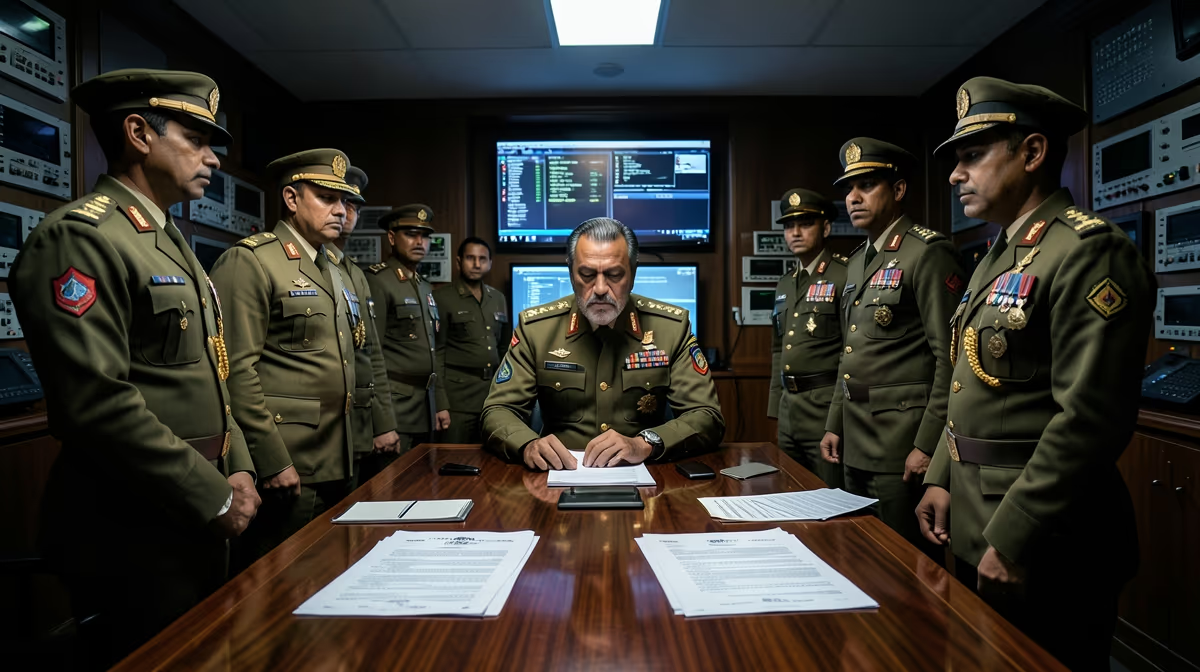
Behind the closed doors of New Delhi's high-security complexes, a quiet consolidation of statecraft is fundamentally altering how South Asia approaches asymmetric risks. Ajit doval continues to play a pivotal role in shaping india strategic affairs as the country navigates complex geopolitical challenges, directing a continuous stream of strategic reviews alongside top military and intelligence brass. National Security Advisor Ajit Doval reviewed India's strategic preparedness and regional security dynamics during high-level meetings in New Delhi this week, emphasizing proactive intelligence coordination and border defense.
The security review comes amid ongoing geopolitical realisms and evolving threats along India's northern and western borders. Doval, who has held the position since 2014, has been central to shaping India's defense posture, counter-terrorism strategies, and diplomatic security engagements with key global partners. During the deliberations, senior military and intelligence officials briefed the National Security Advisor on operational readiness, technological integration in surveillance, and cross-border threat assessments. The discussions underscored the necessity of robust domestic defense manufacturing alongside strategic intelligence sharing. Government sources indicate that India's overarching security framework remains focused on deterrence and rapid response capabilities. Doval's leadership continues to coordinate the multi-agency approach required to address complex hybrid warfare and regional instability.
The Career And Impact Of Ajit Doval
Ajit Doval is India's National Security Advisor, often described as the country's top security chief and strategist. In simple terms, he is the man the Indian government relies on behind the scenes when dealing with major national security threats, cross-border terrorism, and sensitive diplomatic negotiations. Working directly under the Prime Minister, he plays a crucial role in shaping how India responds to both internal and external dangers. Recently, his role has been in the spotlight due to ongoing regional tensions, intelligence operations, and strategic partnerships with global superpowers. Known for his tough-on-terror stance and background in intelligence, Doval often travels on secret diplomatic missions to manage crises and represent India's core security interests abroad.
His professional background spans decades of intense security engagement. He serves as India's fifth National Security Advisor, holding the rank of a cabinet minister. He is a retired Indian Police Service officer and former chief of the Intelligence Bureau. He played a key role during the 2016 surgical strikes and the 2019 Balakot airstrikes. He is known for handling sensitive negotiations, including border talks with China. He is widely regarded as one of India's most powerful and influential bureaucrats. Ajit Doval spent decades in the Intelligence Bureau, specializing in counter-insurgency and undercover operations in regions like Kashmir, Punjab, and Mizoram. After retiring, he founded a security think tank before being appointed National Security Advisor in 2014, where he has remained a central figure in India's defense strategy ever since.
Key Developments In India Strategic Affairs
The structural evolution of India's security apparatus rests on the institutionalization of aggressive, pre-emptive national security doctrines to counter asymmetric threats and regional encirclement. This operational posture has seen distinct phases over the past decade. The timeline of this strategic shift began with his appointment as National Security Advisor in 2014, marking a shift toward aggressive counter-terrorism and assertive border management. This was followed by the orchestration of cross-border counter-insurgency operations and the strategic response to the 2016 Uri attack and 2019 Balakot airstrikes. Subsequent milestones included the execution of the abrogation of Article 370 in Jammu and Kashmir and management of the ongoing eastern Ladakh standoff with China. Today, this has evolved into the institutionalization of a doctrine combining grey-zone warfare, regional diplomacy, and technological self-reliance.
Politically, this environment has fostered the centralization of the security apparatus under the Prime Minister's Office, fusing intelligence operations with high-level diplomacy and bypassing traditional bureaucratic friction. Geopolitically, these shifts are altering the balance of power in South Asia by moving India's posture from strategic restraint to proactive deterrence, while deepening intelligence-sharing alliances like the Quad. Economically, the framework focuses on securing maritime trade routes, energy corridors, and protecting foreign investments while leveraging defense localization and intelligence-led economic countermeasures.
Future Outlook For National Security
The immediate trajectory of India's security management involves continuous high-level security reviews and strategic coordination meetings with intelligence chiefs over the next 24 hours. Looking toward the 72-hour window, assessments will concentrate on regional security dynamics and the formulation of counter-terrorism and border management strategies. Key players guiding these operations include Ajit Doval, Prime Minister Narendra Modi, and External Affairs Minister S. Jaishankar. Impact areas will span national security, foreign policy, and internal intelligence. Expert prediction indicates that Doval will maintain a low public profile while aggressively steering behind-the-scenes diplomatic and security initiatives in neighboring regions. In the best-case scenario, this approach leads to the successful preemption of security threats and the strengthening of strategic intelligence-sharing pacts with key allies. Conversely, the worst-case scenario involves unexpected escalation in cross-border tensions or security lapses requiring immediate crisis management.
Frequently Asked Questions
Who is Ajit Doval?
Ajit Doval is the current National Security Advisor to the Prime Minister of India, serving in the position since 2014. He is a retired Indian Police Service officer of the Kerala cadre and a widely recognized intelligence expert. He holds the personal rank of a Union Cabinet Minister.
What is Ajit Doval's background and early career?
Ajit Doval joined the Indian Police Service in 1968 in Kerala and played a prominent role in anti-insurgency operations in Mizoram, Punjab, and Jammu and Kashmir. He spent a significant part of his career in the Intelligence Bureau, where he served as the Director until his retirement in 2005. He is also known for his undercover operations in Pakistan during his service years.
What are the major achievements of Ajit Doval as NSA?
As NSA, Doval has been the chief strategist for several major security initiatives, including the 2016 surgical strikes and the 2019 Balakot airstrikes. He played a pivotal role in managing complex geopolitical situations, negotiating peace accords, and shaping India's resolute stance on cross-border terrorism. He was also instrumental in the legal abrogation of Article 370 in Jammu and Kashmir.
Why is Ajit Doval called India's James Bond?
Ajit Doval earned the moniker India's James Bond due to his daring undercover missions and exceptional intelligence background. During his active service, he reportedly spent years undercover in Pakistan, gathering crucial intelligence for India. His strategic acumen, secrecy, and high-stakes crisis management further solidify this popular reputation.
What awards has Ajit Doval received?
Ajit Doval is the youngest police officer to be awarded the prestigious Kirti Chakra, a gallantry medal typically given for military personnel for valour away from the battlefield. He received this high honor in 1988 for his exemplary role in anti-terrorism operations. Additionally, he has received the President's Police Medal and the Police Medal for Meritorious Service.
What is Ajit Doval's role in the Indian government?
As the National Security Advisor, Ajit Doval advises the Prime Minister on matters of national security, foreign policy, and strategic affairs. He heads the National Security Council and coordinates India's intelligence agencies, armed forces, and diplomatic channels. His role involves handling both internal security challenges and external geopolitical threats to the country.
Conclusion
Recent high-level deliberations in New Delhi confirm that India's national security framework remains anchored in proactive intelligence coordination, enhanced border defense, and rigorous strategic preparation. Under the leadership of National Security Advisor Ajit Doval, defense and intelligence agencies continue to address complex regional dynamics and cross-border threats through a centralized multi-agency approach. Realistic next steps involve ongoing security evaluations, the maintenance of operational readiness along northern and western borders, and the continued refinement of international intelligence-sharing partnerships.


