
Bangladesh Crisis Is Triggering Shockwaves That Reach Far Beyond Borders
The sudden unravelling of power in Dhaka has sent strategic shockwaves across South Asia, transforming a domestic uprising into a profound test of international diplomacy and border management. As bangladesh remains a crucial focal point for geopolitics in south asia, directly influencing regional stability and international diplomacy, governments across the region are urgently recalibrating their foreign policies to manage the unfolding transition. The departure of long-serving leadership has exposed deep structural vulnerabilities, triggering a complex chain reaction that extends far beyond the nation's borders and places immediate pressures on neighboring security apparatuses.
Current Political Developments in Bangladesh
The current political transition follows months of intense civil unrest that fundamentally altered the nation's governance structure. Prime Minister Sheikh Hasina resigned and left bangladesh in August 2024, bringing an abrupt end to her fifteen-year tenure. The demonstrations originally started as opposition to a controversial government job quota system before transforming into a nationwide anti-regime movement driven by widespread economic frustration and political grievances.
Following her departure, an interim government led by Nobel Peace Prize laureate Muhammad Yunus was established to restore order, reform state institutions, and prepare the country for democratic democratic elections. This administration faces immense institutional challenges, including managing political divisions, addressing economic concerns, and re-establishing the rule of law. The Supreme Court had initially attempted to defuse tensions in June 2024 by altering civil service job quotas, but a subsequent brutal state crackdown on student-led protests in July 2024 only intensified public outrage, culminating in the administration's collapse.
Root Causes of the Crisis
The systemic collapse of the previous regime was driven by a convergence of deep-seated institutional decay and socioeconomic pressures. Analysts point to the weaponization of the judiciary and extreme socioeconomic polarization as fundamental drivers that alienated the youth and the broader populace. Long-term dynastic political entrenchment and the systematic suppression of dissent created an inflexible political environment.
Economically, the country suffered from a stagnation of job growth for a burgeoning youth demographic, compounded by high inflation, foreign exchange reserve depletion, and crony capitalism that concentrated wealth within a narrow ruling elite. Furthermore, the systematic decimation of moderate political opposition inadvertently created a dangerous vacuum, leaving the political landscape increasingly vulnerable to hardline elements. This dynamic mirrors historical precedents, notably the 1969 mass uprising in East Pakistan that eroded authoritarian military rule and catalyzed Bengali nationalism.
Implications for South Asia and Regional Stability
The geopolitical ramifications of the transition in Dhaka are immediate and far-reaching for the surrounding region. As a key neighbor, any political instability, economic disruption, or rise in internal tensions directly affects regional security, trade, and border management for South Asian nations. Ensuring a stable and functioning administration is viewed as vital for peace and prosperity across the entire subcontinent.
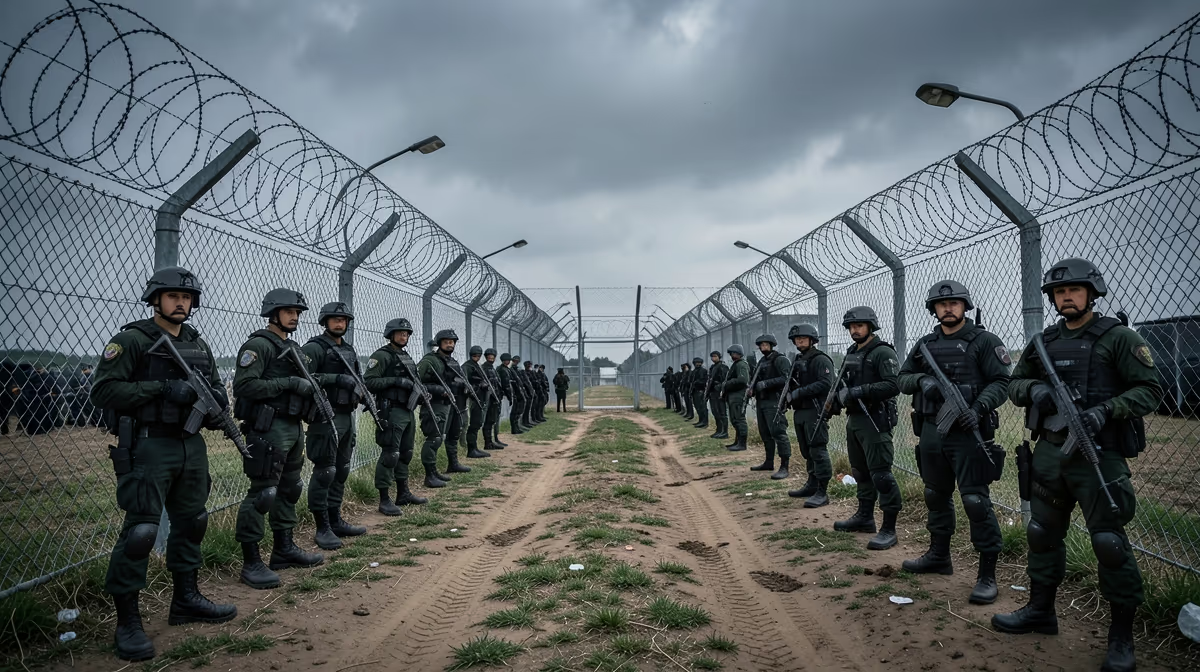
India has heightened security measures along its eastern border following the weeks of political turmoil in Dhaka. The Border Security Force has been placed on high alert along the four thousand ninety-six kilometer international boundary to prevent unauthorized crossings and manage potential refugee influxes. Indian External Affairs Minister S. Jaishankar briefed parliament on the situation, emphasizing that New Delhi is monitoring the welfare of Indian nationals and minority communities within the neighboring country very closely. Border guarding forces have been instructed to remain exceptionally vigilant while diplomatic channels navigate the transition period.
Economic Fallout and Trade Disruptions
The political upheaval has directly impacted commercial activities and supply chains across the border. Trade and transit operations through key land ports, including Petrapole and Agartala, have experienced intermittent disruptions caused by curfews and logistical bottlenecks on the eastern side of the frontier. Commercial bodies on both sides have voiced significant concern over stalled supply chains involving critical commodities such as textiles, agricultural goods, and manufactured items.
The economic partnership relies heavily on smooth cross-border transit, making the current operational friction a matter of pressing urgency for businesses and workers dependent on bilateral trade. Analysts note that restoring full economic stability depends on the interim administration's ability to normalize port operations, secure supply routes, and rebuild investor confidence.
Future Outlook and Strategic Projections
Looking ahead, diplomatic and security indicators point toward a carefully managed, pragmatic approach from regional stakeholders. Within the next twenty-four hours, increased diplomatic engagement between New Delhi and Dhaka is expected regarding border security and minority safety, accompanied by a heightened alert status for security forces along the international border. Over the next seventy--two hours, bilateral intelligence sharing and diplomatic statements are anticipated to address regional stability, trade resumption talks, and the management of cross-border movement.
Experts predict that regional partners will maintain a cautious, pragmatic approach, prioritizing stability and the safety of minorities while engaging constructively with the interim administration in Dhaka. The best-case scenario involves smooth diplomatic communication restoring full stability, ensuring border tranquility, and protecting bilateral economic ties without escalation. Conversely, the worst-case scenario warns that potential spillover effects could lead to refugee influxes, border skirmishes, and prolonged disruption of bilateral trade and diplomatic trust.
Frequently Asked Questions
What is the capital of Bangladesh?
The capital and largest city of Bangladesh is Dhaka. It serves as the cultural, economic, and political hub of the country, located on the banks of the Buriganga River.
What is the official currency of Bangladesh?
The official currency of Bangladesh is the Bangladeshi taka (BDT). Coins and banknotes are issued by the central bank of the country, Bangladesh Bank.
What is the national language of Bangladesh?
Bengali is the official and national language of Bangladesh, spoken by the vast majority of the population. English is also widely used in higher education, government, and business.
Why is Bangladesh famous?
Bangladesh is globally famous for being the world's second-largest exporter of readymade garments. It is also renowned for the Sundarbans, the largest mangrove forest in the world, and its rich cultural heritage.
What is the climate like in Bangladesh?
Bangladesh has a tropical monsoon climate characterized by heavy seasonal rainfall, high temperatures, and high humidity. The country experiences distinct seasons, including the monsoon season which brings vital rains for agriculture.
Do Indian citizens need a visa to visit Bangladesh?
Yes, Indian citizens require a valid visa to enter Bangladesh for tourism, business, or medical purposes. Various types of visas, including tourist and medical visas, can be applied for through the online portal or visa application centers.
Conclusion
The political transition in Dhaka remains a critical focal point for regional security, economic partnership, and international diplomacy in South Asia. While confirmed developments center on heightened border security, active diplomatic engagement, and intermittent trade disruptions, the interim administration continues its efforts to stabilize state institutions and prepare for future democratic elections. Regional stakeholders are maintaining a pragmatic, cautious stance to safeguard bilateral relations and ensure border tranquility as the situation continues to evolve.


