
Smithsonian Secretary Lonnie Bunch Resigns Amid Major Federal Clashes
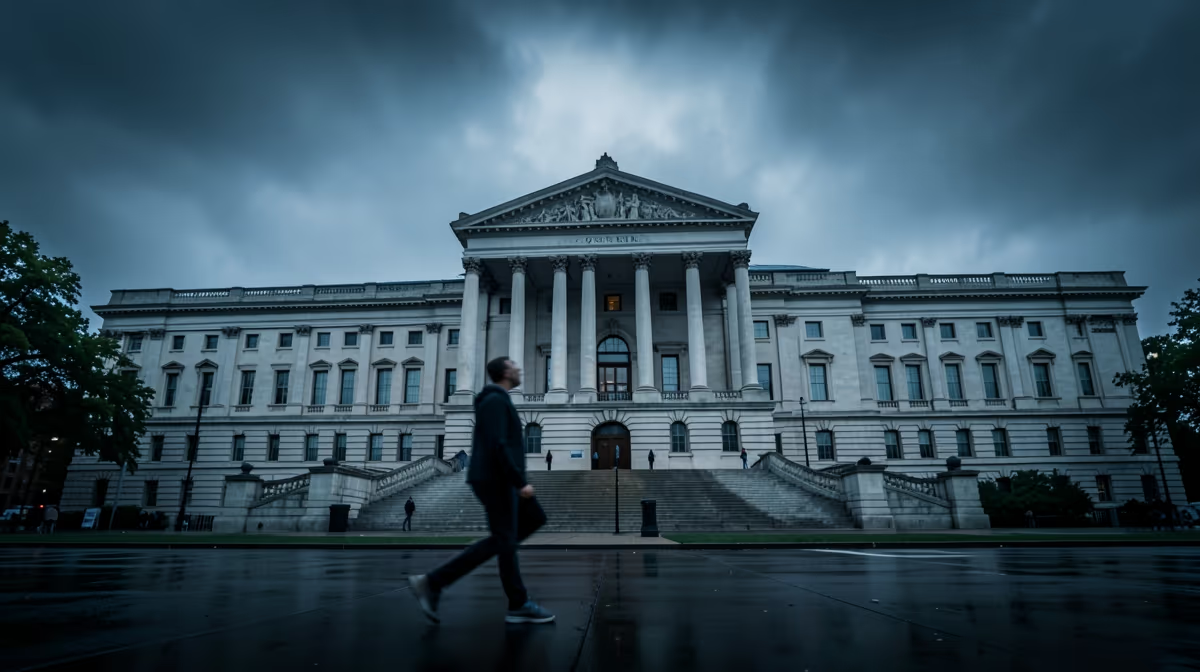
A quiet war over who writes the narrative of American history has culminated in the departure of the country's most prominent cultural guardian. The unexpected announcement that Smithsonian Secretary Lonnie Bunch Resigns has sent shockwaves through the nation's capital, highlighting deep-seated tensions. As the head of the world's largest museum, education, and research complex, Bunch's departure marks a critical turning point in the relationship between independent cultural institutions and executive federal authority. While the Smithsonian has officially framed the exit as a well-earned retirement after nearly four decades of service, the underlying friction points to a far more complex institutional struggle.
The resignation of Lonnie Bunch exposes a deep institutional rift as the federal executive branch seeks to assert unprecedented influence over the narrative, curation, and governance of America's national museums.
Background on the Trump Administration Clashes with Cultural Leaders
The escalating tension between the executive branch and cultural leaders has reached a critical flashpoint. For months, the Trump administration has directed sustained criticism at the Smithsonian’s leadership, signaling a clear desire to exert greater control over the institution's operations, exhibition curation, and historical messaging. This pressure represents a fundamental challenge to the traditional operational independence of federal cultural entities.
The root cause of this high-profile departure lies in intense ideological clashes regarding how history is preserved and presented to the public. As the Trump administration has sought to rule the institution, the conflict has laid bare a systemic struggle over who controls national narratives. For independent museums that rely on federal support, navigating these political demands while trying to maintain historical and scientific integrity has become increasingly difficult. This friction has brought the realities of cultural institution politics in Washington to the forefront of national discourse, demonstrating how executive power can be leveraged to challenge the autonomy of historically independent bodies.
The Dual Narratives of Bunch's Departure
To understand the full scope of this leadership transition, it is necessary to examine how the exit is being communicated by different entities. The official narrative presented by the Smithsonian stands in stark contrast to the political realities reported by major national news outlets.
| Aspect | Official Smithsonian Context | Reported Political Context |
|---|---|---|
| Nature of Exit | Retirement after 38 years of dedicated service to the institution | Resignation following months of intense criticism and clashes |
| Core Driver | Natural career conclusion after historic leadership milestones | Escalating tension over administrative efforts to control museum curation |
| Institutional Stance | Celebrating a lifetime of service and significant developmental milestones | Managing internal and external friction over federal governance and autonomy |
While the official announcement from the Smithsonian focus heavily on Bunch’s historic achievements and his 38 years of dedication, investigative reporting from outlets such as The New York Times, The Wall Street Journal, and CBS News highlights the mounting political pressures that made his continued leadership untenable. This divergence illustrates the delicate balancing act national cultural leaders must perform when their institutional missions collide with the political agendas of the federal administrations that oversee them.
What Next for the Smithsonian After Lonnie Bunch's Departure
With the top leadership seat now vacant, attention shifts to the immediate and long-term steps required to stabilize the institution. The next 24 hours are expected to bring continued media coverage, official reactions from cultural advocacy groups, and formal statements regarding the future of the Smithsonian. Over the next 72 hours, discussions will intensify regarding the leadership transition and the complex process of identifying a successor.
The responsibility of navigating this politically charged vacancy falls directly on the board of regents. As the governing body of the Smithsonian, the board of regents must manage the search for a new Secretary while balancing pressure from an executive branch eager to install leadership aligned with its ideological views. This transition raises pressing questions about whether the Trump administration will push for specific structural changes or seek to influence the selection of the next Secretary, potentially altering the direction of the institution for years to come.
The Political and Economic Dimension
The ramifications of this leadership change extend far beyond museum walls, impacting both the financial health and the global standing of the Smithsonian.
From a domestic political perspective, the struggle represents an effort by the executive branch to reshape how public history is presented. This has direct consequences for the federal funding for museums, as national cultural institutions rely heavily on federal appropriations to maintain daily operations, conduct vital scientific research, and preserve vast archives. When leadership transitions occur under intense political strain, they can complicate the legislative appropriation process, making federal funding a battleground for partisan debates.
Beyond government funding, the economic stability of the world's largest museum complex depends heavily on private philanthropic fundraising. Major donors, foundations, and corporate sponsors value institutional stability and objective curation. Prolonged political battles and high-profile leadership vacuums can deter private capital, putting long-term capital projects and structural expansions at risk.
Furthermore, there is a distinct geopolitical angle to this transition. The Smithsonian serves as a premier soft-power asset, representing American culture, scientific achievement, and historical self-reflection to millions of international visitors and global scholars. When domestic political polarization compromises the leadership of such an institution, it has the potential to weaken national branding, projecting an image of internal instability and ideological censorship to the international community.
A Legacy of Cultural Heritage Preservation
Despite the contentious nature of his departure, Lonnie Bunch leaves behind a monumental legacy defined by a commitment to cultural heritage preservation. Throughout his 38 years of service to the Smithsonian, Bunch championed the inclusion of diverse, complex, and sometimes painful chapters of American history within the national narrative.
His most notable achievement remains the successful founding and opening of the National Museum of African American History and Culture. Under his guidance, the museum became a cornerstone of the National Mall, demonstrating how public spaces can foster deep historical education. His work ensured that marginalized histories were given a permanent, dignified space, establishing a benchmark for how cultural preservation should be conducted on a national scale.
The independence of cultural and educational institutions like the Smithsonian is vital for preserving history and science free from political interference.
This legacy of independent, objective storytelling is precisely what is currently under threat. Historical parallels show that during periods of intense partisan polarization in the United States, government-funded cultural exhibits and museum leadership frequently become targets of political warfare. Bunch’s departure is a modern continuation of these historical battles, illustrating how vulnerable public institutions can be when the executive branch decides to challenge their operational boundaries.
The Shifting Landscape of Federal Governance
The departure of Lonnie Bunch may be the catalyst for a much wider bureaucratic realignment. Beyond the high-profile clashes at the executive level, there is a hidden angle involving the everyday operations of the Smithsonian's various museums, galleries, and research centers.
Curators, historians, and administrative staff must now navigate a highly uncertain environment. As the federal administration seeks to assert greater oversight, individual museum directors and staff members may face increased internal pressure to self-censor or alter upcoming exhibitions to avoid administrative backlash. This shifting landscape threatens to disrupt the traditional bottom-up curation process, where scientific and historical experts dictate content, replacing it with a top-down model influenced by federal political appointees.
This struggle highlights the ongoing debate over how publicly funded cultural spaces should be governed. While the Smithsonian is partially funded by the federal government, it was established to operate with a degree of independence to safeguard its scientific and historical integrity. The current pressure to rule the institution threatens to dissolve this boundary, creating a precedent where changing political administrations can directly dictate the contents of national exhibits.
Future Outlook and Institutional Stability
As the Smithsonian enters this uncertain transition period, expert analysts are predicting a period of heightened scrutiny regarding the autonomy of national educational and cultural organizations. The resolution of this crisis will depend heavily on the actions of the Board of Regents and the level of pushback from cultural advocates.
Under the best-case scenario, the Board of Regents will successfully execute a leadership transition that safeguards the Smithsonian’s historical mission. This would involve appointing a respected, independent successor who can cooperatively navigate federal oversight without sacrificing the scientific and historical integrity of the museums. Such a transition would restore confidence among donors, staff, and the public, preserving the institution's educational mandate.
Conversely, the worst-case scenario involves the deepening politicization of the national museum complex. If the search for a successor becomes a protracted political battle, it could lead to a prolonged leadership vacuum and institutional instability. This outcome would likely accelerate a talent drain of top curators and researchers, damage philanthropic partnerships, and lead to an era of censorship that compromises the Smithsonian's role as an objective chronicler of American and global history.
Frequently Asked Questions
Why did Lonnie Bunch resign from Smithsonian?
While officially framed as a retirement after 38 years of dedicated service to the institution, Lonnie Bunch's resignation comes amid months of heavy criticism and intense clashes with the Trump administration, which has sought to exert greater control and influence over the organization.
What was the Trump administration tension with cultural leaders about?
The tension centers on the administration's efforts to assert more executive influence and control over the governance, curation, and narratives of independent, publicly funded cultural and historical institutions like the Smithsonian.
How does this impact the Smithsonian museums?
The leadership transition and political clashes raise concerns over future institutional autonomy, potential censorship of exhibits, impacts on federal funding, and the stability of private philanthropic fundraising for long-term projects.
What is the role of the Board of Regents during this transition?
The Smithsonian Board of Regents is the governing body responsible for managing the leadership transition and conducting the search for a successor to replace Lonnie Bunch as Secretary.
Conclusion
The resignation of Smithsonian Secretary Lonnie Bunch is a watershed moment for American cultural policy, bringing the realities of political pressure on independent institutions into sharp focus. While officially retiring after a historic 38-year career—highlighted by his leadership in opening the National Museum of African American History and Culture—Bunch’s departure is inextricably linked to months of escalating clashes with the Trump administration. As the Board of Regents begins the complex process of searching for a successor, the future of the world's largest museum complex hangs in a delicate balance. The coming months will determine whether the Smithsonian can preserve its historical and scientific autonomy, or whether it will undergo a fundamental structural shift under the influence of intensifying federal oversight.
Sources
- Smithsonian’s Secretary to Resign as Trump Tries to Rule the Institution — The New York Times
- Lonnie Bunch Says He Will Resign As Secretary Of The Smithsonian — deadline.com
- Secretary Lonnie G. Bunch III Announces Retirement as Head of the Smithsonian After 38 Years of Service to the Institution — Smithsonian Magazine
- Smithsonian Secretary Lonnie Bunch Steps Down Amid Strife With Trump — WSJ
- Lonnie Bunch, Smithsonian leader, announces retirement after months of Trump administration criticism — CBS News
- Smithsonian Secretary Lonnie Bunch to Step Down — Daily Signal


