
Boeing 747 Era Ends With a Shift That Rewrites Global Aviation
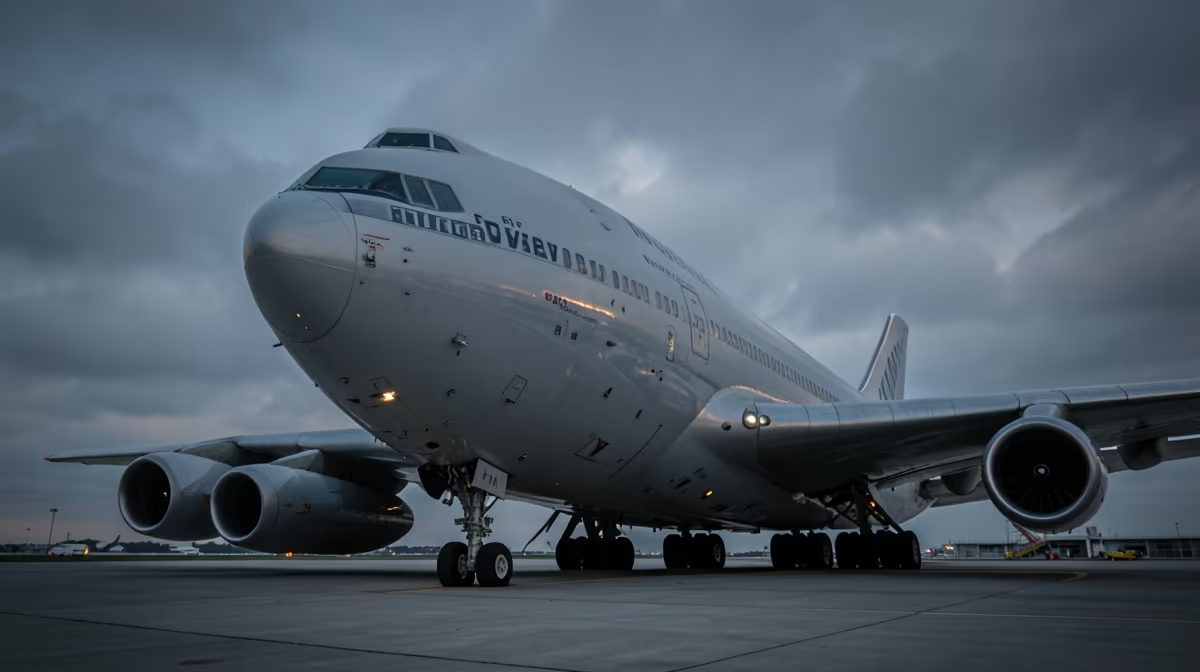
Boeing has officially ended the production run of its iconic boeing 747 Queen of the Skies, delivering the final freighter to Atlas Air on January 31, 2023, at the Everett factory in Washington, marking the conclusion of a 55-year manufacturing era that fundamentally transformed commercial and cargo aviation. Fifty-four years after its historic rollout, the monumental engineering marvel that revolutionized international travel and heavy cargo logistics has ceased manufacturing lines, leaving an indelible imprint on the global aerospace landscape and shifting the trajectory of modern aviation trends.
Historical Context And Development
Developed in the late 1960s by Boeing in response to the growing popularity of commercial air travel, the 747 was originally designed as a military transport before being adapted for commercial passengers. It revolutionized long-haul flights by dramatically increasing passenger capacity and cutting travel costs. The aircraft made its very first flight in February 1969 and was the world's first wide-body airplane, featuring two aisles in the cabin and its signature hump near the front. More than 1,500 planes were built over its historic production run, serving as a versatile platform that could carry hundreds of passengers and even transport NASA space shuttles. The very first commercial flight took place on January 22, 1970, operated by Pan American World Airways. Named the Clipper Young America, the iconic journey from New York's John F. Kennedy International Airport to London Heathrow officially inaugurated the jumbo jet era of commercial aviation.
The Mechanics Of Industrial Transition
Industrial consolidation prioritizing short-term shareholder value over long-term aerospace engineering dominance, combined with the structural obsolescence of four-engine widebody aircraft in an era of ultra-efficient twin-engine jets, sealed the fate of the Queen of the Skies. Despite its revolutionary impact, shifting industry economics ultimately forced the aircraft's retirement. Modern twin-engine jets, such as Boeing's own 777X and the Boeing 787 Dreamliner, offer superior fuel efficiency and lower operating costs, rendering the four-engine boeing 747 economically unviable for most commercial passenger airlines in recent decades. The soaring cost of fuel and maintenance for four engines ultimately relegated its final decades to a niche cargo workhorse. The retirement of the 747 mirrors the broader historical parallel of the Concorde, which similarly marked the end of an era where technical audacity outweighed economic efficiency, yielding to a more homogenized, cost-conscious global transit network.
Geopolitical And Economic Dimensions
The boeing 747 represents the zenith of American industrial policy and defense-aerospace symbiosis, functioning as both a floating embassy and a cornerstone of American projection of soft and hard power. Its design was heavily influenced by United States Air Force logistics requirements during the Cold War, specifically the C-5 Galaxy competition, meaning its entire 50-year civilian reign was subsidized and shaped by military-industrial imperatives. Its decline mirrors the broader erosion of high-skilled manufacturing hegemony and the regulatory capture that traded strict oversight for corporate self-regulation. Furthermore, its retirement symbolizes the shift in global aviation dominance toward European hubs and Airbus, alongside the rising threat of state-backed aerospace competitors in Asia.
Current Operations And Cargo Legacy
Even as production ceases, the existing global fleet of boeing 747 freighters is expected to remain operational for many years due to its unmatched payload capacity and unique nose-loading door. Major cargo operators, including Atlas Air, UPS Airlines, and Federal Express, continue to rely heavily on the aircraft to transport oversized freight across global supply chains. Cargo operators continue routine transatlantic and transpacific flights with remaining active freighters, while aviation enthusiasts track the final passenger variants. MRO facilities schedule upcoming heavy maintenance checks for aging 747-8 freighters, and logistics firms assess fleet longevity amid rising demand for outsized cargo capacity. Boeing CEO Dave Calhoun stated during the final delivery ceremony that this monumental day is a true testament to the generations of Boeing employees who brought to life the airplane that changed the world, while leadership from the program emphasized that while manufacturing stops, the legacy continues.
Frequently Asked Questions
Why is the Boeing 747 called the Queen of the Skies?
The Boeing 747 earned the majestic nickname Queen of the Skies due to its unprecedented size, luxurious upper deck, and revolutionary wide-body design. As the world's first wide-body commercial airliner, it completely transformed international travel and set a new standard for luxury in the aviation industry. Its iconic hump and massive silhouette made it instantly recognizable across the globe.
When was the last Boeing 747 built?
The final Boeing 747, the 1,574th aircraft produced, rolled off the assembly line in Everett, Washington, on December 6, 2022. It was officially delivered to Atlas Air in January 2023, marking the end of an era that lasted over 50 years. This momentous event closed the chapter on the most famous production run in aviation history.
Why did Boeing stop making the 747?
Boeing decided to end 747 production primarily because modern twin-engine aircraft, such as the Boeing 777 and 787 Dreamliner, became much more fuel-efficient and cost-effective for airlines. Four-engine jumbo jets fell out of favor as point-to-point travel replaced the traditional hub-and-spoke model. Additionally, the immense manufacturing costs could no longer be justified by dwindling commercial demand.
Are any US airlines still flying the Boeing 747?
No major US passenger airlines currently operate the Boeing 747 in their active fleets. United Airlines and Delta Air Lines retired their final passenger 747s in 2017, and other carriers quickly followed suit. However, US-based cargo carriers like Atlas Air and UPS still operate 747 freighters to transport heavy goods worldwide.
How many passengers can a Boeing 747 carry?
Depending on the specific variant and airline cabin configuration, a typical Boeing 747 can comfortably seat between 400 and 500 passengers across multiple classes. High-density charter configurations have historically accommodated over 600 passengers in a single-class layout. This massive capacity was a major breakthrough that drastically lowered the cost of long-haul international air travel.
What was the first commercial flight of the Boeing 747?
The very first commercial Boeing 747 flight took place on January 22, 1970, operated by Pan American World Airways. Named the Clipper Young America, the iconic flight traveled from New York's John F. Kennedy International Airport to London Heathrow. This historic journey officially inaugurated the jumbo jet era of commercial aviation.
Conclusion
The official conclusion of the Boeing 747 manufacturing run marks the end of a transformative 55-year chapter in aerospace history. While passenger variants have disappeared from major commercial airline fleets, the remaining active freighters will continue to serve as vital workhorses in global logistics for years to come. The iconic Queen of the Skies leaves behind an enduring legacy defined by technological audacity, industrial scale, and a permanent shift toward modern, efficient twin-engine aviation.


