
SpaceX Launch Today Reveals Major Shift In Orbital Cadence
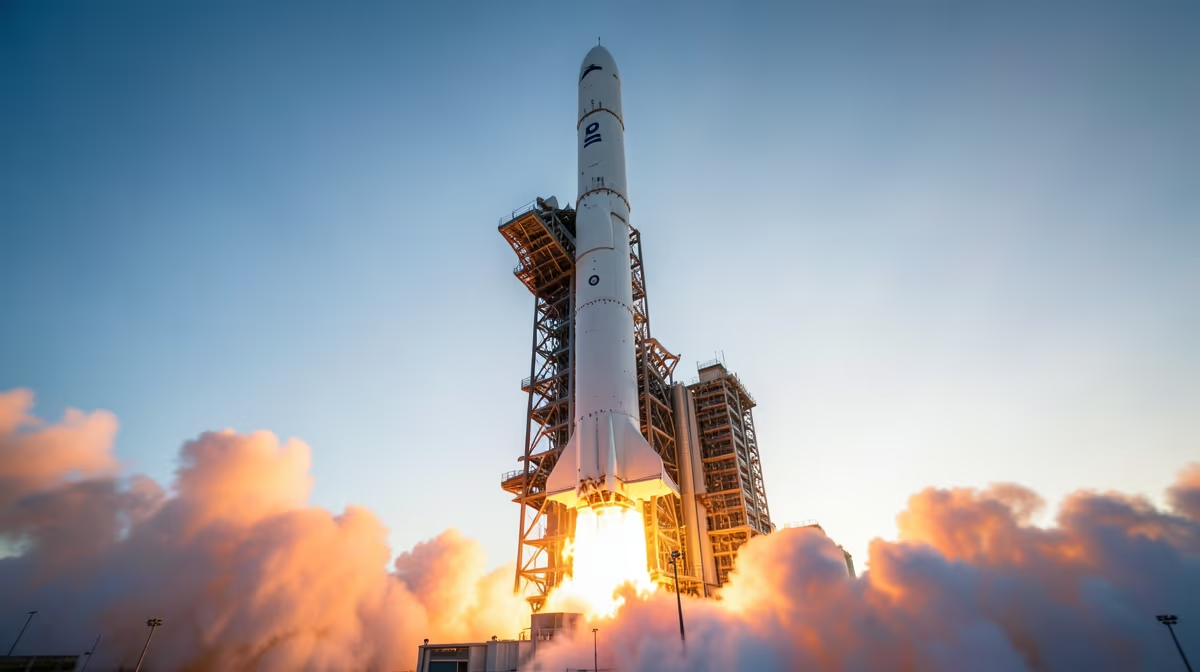
Civilization's trajectory toward multi-planetary permanence no longer rests on theoretical speculation, as routine orbital cadences increasingly blur the line between science fiction and industrial reality. Executing a seamless ascent from the coastline of Florida, the aerospace enterprise executed another textbook mission that highlights how rapidly the economics of space access are shifting. SpaceX successfully launched a Falcon 9 rocket carrying 23 Starlink satellites from Space Launch Complex 40 at Cape Canaveral Space Force Station on Tuesday morning, marking the company's 85th orbital flight of the year. This operational frequency underpins a broader commercialization of space infrastructure driven by private monopolies, national security reliance, and aggressive cost-reduction paradigms that are actively transforming the global aerospace landscape.
Chronology Of The Flight
Liftoff occurred precisely at 8:14 a.m. EST, proceeding smoothly as the two-stage rocket cleared the launch tower and headed northeast over the Atlantic Ocean. Approximately 8.5 minutes after launch, the Falcon 9 first-stage booster successfully returned to Earth, landing upright on SpaceX's autonomous droneship named Just Read the Instructions positioned offshore. This mission utilized the booster for the 14th time, reinforcing the manufacturer's industry-leading cadence in rapid hardware reuse. The payload deployment sequence began roughly 65 minutes post-launch, with all 23 Starlink internet satellites successfully released into low-Earth orbit. Flight controllers confirmed nominal separation and telemetry data indicating the spacecraft established stable communication and power generation shortly after deployment. Tuesday's launch continues a busy operational tempo as the firm works to expand global broadband coverage through its growing satellite constellation. The Federal Aviation Administration and local authorities managed temporary airspace and maritime closures to ensure public safety during the ascent. During the live launch broadcast, SpaceX lead manufacturing engineer Siva Bharadvaj noted that another flawless ascent and landing for the Falcon 9 fleet brings high-speed internet capability one step closer to underserved regions worldwide.
Core Mechanics And Verification
The operational architecture of modern commercial spaceflight relies heavily on reusable rocketry and standardized payload deployment. The launch utilized a flight-proven Falcon 9 rocket that lifted off from a major US spaceport. Following stage separation, the rocket booster successfully landed on an autonomous droneship in the ocean, a routine maneuver that highlights the company's industry-leading ability to reuse expensive rocket hardware. This process makes space travel faster and much more affordable by eliminating the need to manufacture new boosters for every flight. The mission successfully deployed critical payloads into low-Earth orbit, with operations managed safely by the SpaceX mission control team. Initial orbit-raising maneuvers by the newly deployed Starlink satellites and their eventual integration into the operational broadband network are currently underway. The commercialization of space infrastructure by private entities has also created a shifting dynamic in global aerospace power. This shift moves the locus of authority from traditional bureaucratic defense contractors and NASA to an unaccountable corporate titan, intertwining state interests with private corporate governance. By disrupting the global launch market through vertical integration and reusable rocketry, the company has effectively created a de facto monopoly that undercuts foreign state agencies and compresses competitor margins. At the same time, this dominance secures American technological hegemony in low-Earth orbit and cislunar space while weaponizing supply chain dominance to dictate terms to allies and adversaries alike. This dynamic creates a complex intersection where sovereign critical communications and military intelligence infrastructure are closely tied to the commercial interests and operational rhythms of a single private entity, mirroring the early 20th-century aviation boom and the rise of the military-industrial complex during the interwar and Cold War periods when private titans became direct extensions of state power.
Future Outlook And Immediate Trajectory
Looking ahead, operations across the aerospace sector remain highly active with several anticipated milestones across the next 24 to 72 hours. The immediate operational window involves the completion of pre-launch checks, fueling procedures, and final weather assessments for upcoming rocket launches. Following these preparations, successful liftoff and payload deployment will be followed by booster recovery operations and initial telemetry data analysis. Industry experts predict that upcoming missions will proceed within scheduled windows, achieving all primary mission objectives and successfully landing first-stage boosters. In a best-case scenario, operations will feature flawless launches with 100 percent precise orbit insertions, successful droneship landings, and zero debris anomalies, thereby boosting investor confidence and maintaining the rapid cadence of infrastructure deployment. Conversely, worst-case scenarios could involve launch aborts due to technical or weather anomalies, or in-flight failures resulting in payload loss and temporary Federal Aviation Administration grounding of the fleet.
Frequently Asked Questions
Where do SpaceX launches take place in the US?
SpaceX primarily launches its rockets from three main sites in the United States. These include Launch Complex 39A at the Kennedy Space Center and Space Launch Complex 40 at Cape Canaveral Space Force Station in Florida. Additionally, they operate Space Launch Complex 4 East at Vandenberg Space Force Base in California for polar orbit missions.
How can I watch a SpaceX launch in person?
Spectators can view SpaceX launches from various public areas along the Florida Space Coast, such as Jetty Park, Playalinda Beach, and the Kennedy Space Center Visitor Complex. Many viewing locations offer bleachers, audio commentary, and close-up views of the pad. It is always recommended to check launch schedules and arrival guidelines ahead of time, as viewing spots can fill up quickly.
How much does a ticket to space with SpaceX cost?
While SpaceX does not publish a standardized ticket price for private orbital flights, commercial missions typically cost tens of millions of dollars per seat. For instance, private astronaut missions to the International Space Station via Axiom Space have historically cost around $55 million per person. Costs for private chartered flights on Crew Dragon or Starship vary based on the specific mission parameters and duration.
Can SpaceX rocket boosters be reused?
Yes, SpaceX has pioneered orbital-class rocket booster reusability to significantly reduce the cost of access to space. After stage separation, Falcon 9 first-stage boosters guide themselves back to land on a concrete pad or land on an autonomous droneship stationed in the ocean. These recovered boosters are then refurbished and flown multiple times on subsequent missions.
What is the schedule for upcoming SpaceX launches?
SpaceX maintains a very active launch manifest with missions scheduled almost weekly for commercial satellites, NASA cargo, and Starlink internet constellations. The most reliable way to check the upcoming schedule is through the official SpaceX website or trusted aerospace tracking platforms like Spaceflight Now. However, launch dates are always subject to change due to weather conditions, technical readiness, and range availability.
What are SpaceX Starlink launches?
Starlink launches are dedicated missions designed to deploy batches of internet satellites into low Earth orbit. These satellites work together as a mega-constellation to provide high-speed, low-latency broadband internet to underserved and remote areas globally. Typically launched using Falcon 9 rockets, dozens of Starlink satellites are packed tightly inside the payload fairing and released simultaneously in orbit.
Conclusion
The successful execution of the 85th orbital flight of the year from Cape Canaveral underscores the mature operational cadence of modern commercial launch providers. With the Falcon 9 booster completing its 14th flight and all 23 Starlink satellites successfully deployed into low-Earth orbit, the aerospace manufacturer continues to reshape global connectivity and launch economics. Regulatory oversight by the Federal Aviation Administration and ongoing range operations remain critical to maintaining public safety as the manifest advances toward subsequent pre-launch preparations and orbit-raising maneuvers.


