
RAF Typhoon Jets Intercept Qatar Flight Over UK Airspace
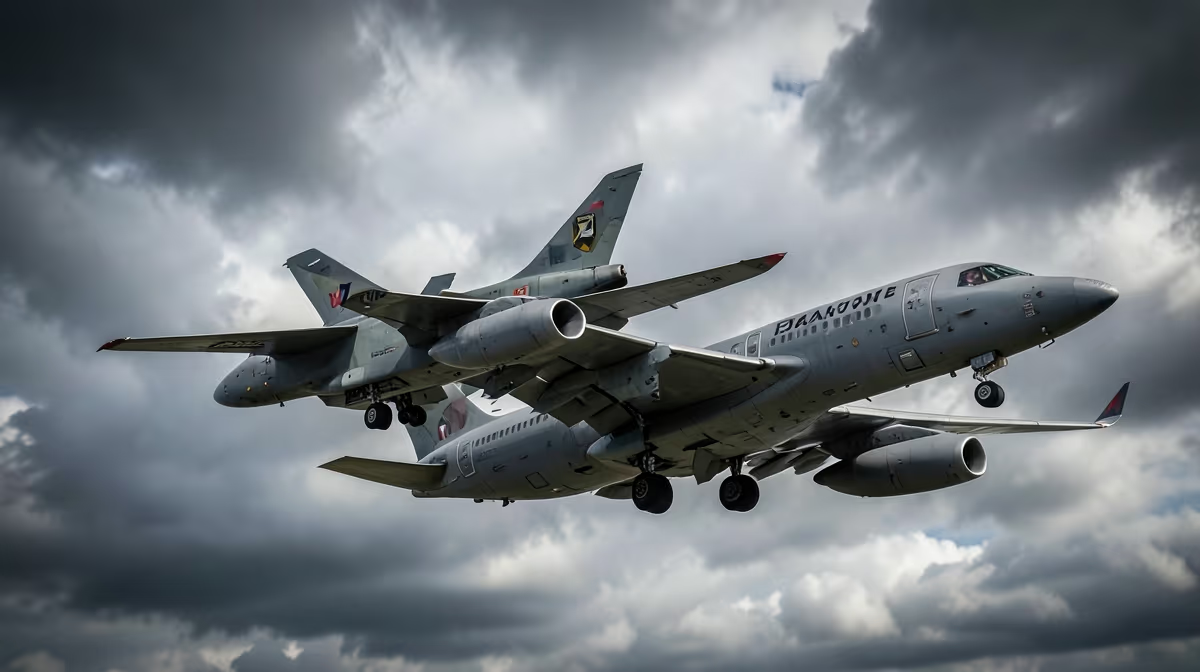
Two Royal Air Force Typhoon jets were scrambled from RAF Coningsby to intercept a Qatar Airways flight over the UK on Saturday, after reports of a potential security threat on board. Emergency services and defense officials confirmed that typhoon jets intercept qatar flight following a security alert that triggered rapid tactical military responses across British airspace. The passenger aircraft, operating Flight QR23 from Doha to Manchester, was escorted by the military jets as a precautionary measure while still in British airspace, causing loud sonic booms to echo across parts of northern England as the fighters rushed to intercept the plane.
What Unfolded
Air traffic control and security services coordinated the response following concerns raised about the safety of the flight after radio contact was temporarily lost, which triggered automated air defense alerts and Quick Reaction Alert protocols. Two Royal Air Force Typhoon fighter jets were scrambled to intercept the passenger flight as it traveled through the UK flight information region. Visual identification confirmed safety parameters were being monitored, and the aircraft was guided toward its designated landing zone. Upon landing safely at Manchester Airport, the aircraft was directed to a remote stand away from the main terminal buildings. Emergency services, including armed police and fire crews, surrounded the plane to conduct immediate security checks and investigate the nature of the reported threat. Operations at Manchester Airport experienced brief precautionary disruptions while the aircraft was brought to a secure area. Specialist teams boarded the plane to carry out a full sweep and interview passengers and crew members as part of the ongoing security protocol. A spokesperson for Greater Manchester Police stated that officers were actively responding to the incident involving the incoming flight and working closely with partners to establish the full circumstances. Following a thorough investigation by Greater Manchester Police, it was determined that the security threat stemmed from an individual on board who had allegedly made a bomb threat and communicated false information regarding a safety threat. A 45-year-old man was arrested at Manchester Airport immediately after the aircraft landed and taken into custody on suspicion of making a bomb hoax, while no suspicious items or explosive devices were ultimately found on the aircraft.
Key Developments and Verified Facts
The incident involved specific operational actions and verified responses from military and civilian agencies. Two RAF Typhoon jets were scrambled from RAF Coningsby following automated air defense alerts and reports of a potential security threat on board. The aircraft involved was Qatar Airways Flight QR23 operating the route from Doha to Manchester. The rapid deployment of the eurofighter typhoon aircraft required them to break the sound barrier, resulting in a loud sonic boom that startled residents across parts of northern England, for which the RAF later apologized. The plane landed safely at Manchester Airport, where emergency services met the aircraft upon arrival on the runway. Passengers and crew were subsequently disembarked safely while authorities conducted security checks, and no injuries or immediate dangers to the public were reported following the safe landing. A 45-year-old man was arrested on suspicion of making a bomb hoax, and subsequent police sweeps confirmed that no explosive devices were found on board.
Why This Matters
Incidents like this highlight the rapid response capabilities of national security forces when potential threats arise in British airspace. While alarming for local residents who heard the loud sonic booms, the swift military and police coordination ensures that passenger safety remains the top priority in emergency situations. The situation underscores the reliance on rapid tactical military responses when civil aviation corridors experience communication interruptions or security concerns. The event directly affects passengers and crew on the Qatar Airways flight, local residents startled by the sonic booms, and travelers experiencing brief operational disruptions at Manchester Airport. Grounded in standard operational procedures, RAF Typhoon jets are regularly kept on quick-reaction alert at UK bases to intercept unidentified or potentially threatening aircraft entering British airspace, ensuring continuous national security oversight.
Political and Geopolitical Context
The event demonstrates the UK's rapid-reaction sovereignty and unwavering commitment to homeland defense amid fluctuating Gulf-Western diplomatic relations. Underlying friction regarding airspace management protocols and the intersection of Gulf state aviation diplomacy with Western security architectures often informs these high-visibility military scrambles. Heightened domestic security protocols and automated threat responses in the UK follow strict intelligence frameworks regarding uncommunicative civil aviation corridors. The situation reflects historical parallels to post-9/11 intercept protocols for foreign commercial airliners over European capitals under suspected hijack or communication blackout conditions. The reliance on algorithmic intercept triggers allows defense architectures to bypass prolonged diplomatic channels in favor of immediate tactical military responses, reinforcing the boundaries of national airspace sovereignty.
Economic Fallout and Operational Impact
The interception event carries clear economic and operational implications for commercial aviation and defense logistics. Disruption costs for commercial carriers include gate reassignments, temporary terminal holds, and schedule adjustments at major hubs like Manchester Airport. Insurance premium volatility for Middle Eastern routes can experience marginal upward pressure following high-profile security incidents involving major regional carriers. Furthermore, the high operational expenditure of scramble sorties places immediate financial demands on defense budgets for fuel, maintenance, and flight hours associated with Quick Reaction Alert deployments.
Expert Outlook and Future Scenarios
Defense analysts and international security experts project specific trajectories for the bilateral and operational aftermath of the incident. In the next 24 hours, increased diplomatic exchanges between the UK and Qatari authorities are expected, alongside a preliminary RAF incident report to clarify the interception protocols. Over the next 72 hours, the release of official joint statements regarding air safety protocols, potential parliamentary questioning in the UK, and reassurance of standard operational procedures for commercial routes will likely follow. Expert prediction indicates the incident will be classified as a standard security scare or procedural miscommunication, quickly de-escalated through existing military-diplomatic channels without long-term bilateral damage. The best-case scenario involves a transparent joint investigation swiftly confirming it was a false alarm or minor communication glitch, leading to reinforced coordination and renewed commitments to flight safety. Conversely, the worst-case scenario would involve conflicting narratives emerging regarding communication failures, leading to public friction, heightened political scrutiny, and temporary disruptions in aviation cooperation. Key players managing the response include the UK Royal Air Force, Qatar Airways, the UK Ministry of Defence, and the Qatari Embassy in London, with impact areas centered on UK-Qatar diplomatic relations, commercial aviation security standards, and RAF intercept protocols.
Frequently Asked Questions
Why were RAF Typhoon jets scrambled to intercept a Qatar Airways flight?
RAF Typhoon jets were deployed to intercept a Qatar Airways flight due to a security alert onboard involving a suspicious device. Two fighter jets from RAF Coningsby caused a sonic boom while rushing to escort the civilian airliner safely to its destination, prompting a swift emergency response to ensure the safety of all passengers and crew.
Where did the Qatar Airways flight intercepted by Typhoon jets land?
The flight, traveling from Doha to Manchester, was escorted by the RAF fighters and landed safely at Manchester Airport. Emergency services, including police and fire crews, met the aircraft upon arrival on the runway, and passengers were subsequently disembarked safely while authorities conducted security checks.
Was a bomb found on the Qatar Airways flight intercepted by Typhoons?
Following a thorough investigation by Greater Manchester Police, it was determined that the security threat was a false alarm. A man on board had allegedly made a bomb threat, leading to the deployment of the military jets, but no suspicious items or explosive devices were ultimately found on the aircraft.
What happened to the passenger accused of making the threat on the Qatar flight?
A 45-year-old man was arrested at Manchester Airport immediately after the aircraft landed. He was taken into custody on suspicion of making a bomb hoax and communicating false information regarding a safety threat, and the police launched a full investigation into his actions during the flight.
Did the RAF Typhoon intercept cause a sonic boom over the UK?
Yes, the rapid deployment of the Typhoon jets to reach the civilian aircraft required them to break the sound barrier. This supersonic speed resulted in a loud sonic boom that startled residents across parts of northern England, and the RAF later apologized for any public concern caused by the sudden noise.
What is the standard RAF protocol when a flight is intercepted?
When a commercial flight triggers a security alert, Quick Reaction Alert Typhoon fighters are scrambled to intercept and visually inspect the aircraft. The military pilots assess the situation and escort the plane away from populated areas or guide it to a safe landing site to mitigate potential airborne threats swiftly and effectively.
Conclusion
The interception of Qatar Airways Flight QR23 by Royal Air Force Typhoon jets concluded safely at Manchester Airport following a coordinated response to an onboard security threat. Confirmed developments established that the aircraft was successfully escorted, landed without incident, and met by emergency services who arrested a 45-year-old man in connection with a bomb hoax. Subsequent police investigations verified that no explosive devices were present on the aircraft. Realistic next steps involve ongoing diplomatic communications between UK and Qatari authorities, the release of preliminary RAF and police incident reports, and the continuation of standard operational procedures across commercial aviation and defense corridors.


