
SpaceX Falcon 9 Launch Clears Cape Canaveral For Major Flight
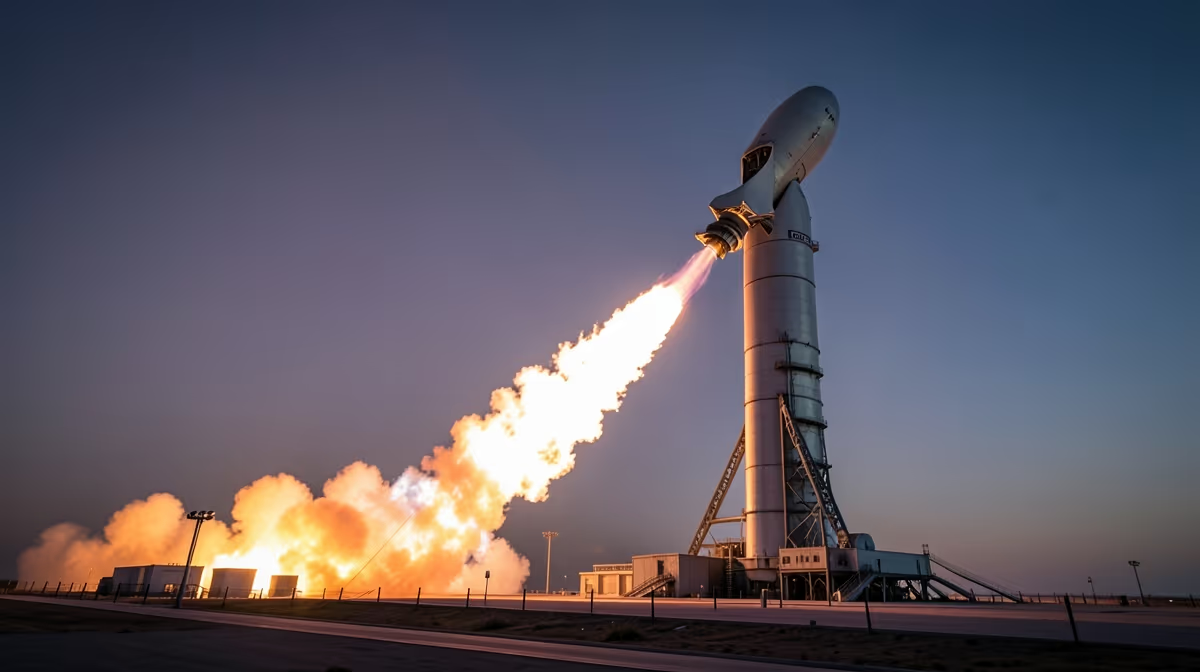
SpaceX successfully launched another batch of 23 Starlink internet satellites into low-Earth orbit from Space Launch Complex 45 at Cape Canaveral Space Force Station in Florida early Tuesday morning, marking the company's 85th orbital flight of the year. Stay informed with real-time coverage of the latest spacex launch as aerospace history unfolds. The Falcon 9 rocket lifted off at 4:32 a.m. EST, piercing the morning sky as its first-stage booster successfully returned to Earth about 8.5 minutes later, touching down smoothly on the 'A Shortfall of Gravitas' droneship stationed in the Atlantic Ocean. This mission represented the 14th flight for this particular booster, highlighting SpaceX's ongoing commitment to rapid rocket reusability. Following stage separation, the rocket's upper stage continued its trajectory, deploying the 23 spacecraft into low-Earth orbit approximately 65 minutes after liftoff. The newly added satellites join a mega-constellation of thousands of active nodes designed to provide high-speed, low-latency broadband internet to underserved and remote regions globally. Regulatory oversight for the launch was managed by the Federal Aviation Administration, which cleared the flight following routine safety and environmental reviews. The successful deployment keeps SpaceX on track to exceed its ambitious annual launch manifest, reinforcing its dominant position in the global commercial launch market.
Mission Details and Flight Objectives
The mission successfully executed its primary objectives by placing all 23 Starlink satellites into their targeted low-Earth orbit. Falcon liftoff confirmed, expanding global connectivity one mission at a time, stated SpaceX launch commentator Jessica Anderson during the live broadcast, emphasizing the operational tempo of the aerospace firm. Verified facts confirm that SpaceX launched 23 Starlink satellites on a Falcon 9 rocket from Cape Canaveral Space Force Station in Florida. Furthermore, the first-stage booster successfully landed on the droneship 'A Shortfall of Gravitas' during its 14th flight. What is confirmed includes the successful landing of the Falcon 9 first stage and the precise deployment of all 23 satellites. What is developing involves the ongoing expansion of the Starlink constellation and future regulatory approvals for higher launch frequencies from the Cape Canaveral site.
Company Background and Industry Evolution
SpaceX is a private American aerospace company that has completely founded by billionaire entrepreneur Elon Musk, designed to manufacture and launch advanced rockets and spacecraft with the ultimate goal of making human life multi-planetary. Instead of letting expensive rocket parts sink into the ocean after a single launch, the firm figured out how to land them safely back on Earth so they can be reused again and again. Today, the corporation stands as the leading provider of launch services in the United States, carrying supplies to the International Space Station, launching commercial satellites into orbit, and sending NASA astronauts into space. They are also building a massive next-generation rocket called Starship, which Musk hopes will eventually carry humans to the Moon and Mars. This commercial success stems from the commodification of orbital access and the erosion of traditional state-run aerospace monopolies through aggressive vertical integration and cost-reduction paradigms.
Economic Fallout and Market Disruption
The rise of the commercial aerospace firm has triggered structural disruptions across the global launch market, establishing near-monopoly pricing power and capturing critical infrastructure revenue streams while threatening legacy aerospace giants with structural obsolescence. SpaceX matters because it has transformed space from an exclusive playground for government agencies into a bustling commercial frontier. By drastically reducing the cost of getting materials and people into orbit, the company has accelerated scientific research, improved global communications through satellite internet, and revitalized America's leadership in human spaceflight. Everyday internet users in rural areas, NASA and other government space agencies, global telecommunications companies, and future generations who may witness humanity establish a permanent presence on the Moon and Mars are all directly affected by these developments. Historically, this mirrors the Dutch East India Company's fusion of corporate commercial enterprise with militarized sovereign expansion during the seventeenth-century golden age of maritime trade.
Political Dimension and Sovereign Dependency
The political angle reveals a symbiotic yet contentious dependency between the United States federal government, specifically the Department of Defense and NASA, and a private corporate entity, shifting sovereign space capabilities into the hands of a single actor. Geopolitically, this redefines national security and global telecommunications architecture, where United States hegemony in low-Earth orbit and asymmetric warfare capabilities via Starlink are dictated by corporate operational reach. The hidden angle involves the unprecedented concentration of dual-use infrastructure under private governance, creating a framework capable of bypassing international diplomacy and traditional state-to-state conflict norms. Timeline milestones include NASA awarding the Commercial Orbital Transportation Services contract to the firm in 2008, saving the near-bankrupt enterprise and cementing public-private dependency, followed by Starlink deployment beginning in 2019 to weaponize mega-constellations for commercial telecom dominance and battlefield communications, leading to undisputed global launch hegemony.
What Comes Next
Routine preparations for upcoming Starlink satellite launches and standard telemetry analysis from recent flight tests dominate the next 24 hours. Over the next 72 hours, updates on launch window schedules from the Federal Aviation Administration and mission readiness milestones at Starbase and Cape Canaveral are expected. Key players guiding these operations include Elon Musk, Gwynne Shotwell, and regulatory officials from the Federal Aviation Administration. Impact areas remain centered on commercial satellite communications and the global launch services market. Expert prediction suggests that SpaceX will continue to maintain a high cadence of orbital launches while navigating regulatory reviews for next-generation Starship testing. The best case outlines successful regulatory approval for upcoming uncrewed Starship orbital flight tests and flawless deployment of new Starlink constellations, while the worst case warns of unexpected regulatory delays or technical anomalies during static fire testing that push back major launch milestones.
Frequently Asked Questions
What is SpaceX and who owns it?
SpaceX, or Space Exploration Technologies Corp., is a private American aerospace manufacturer and space transportation services company. It was founded in 2002 by billionaire entrepreneur Elon Musk with the ultimate goal of reducing space transportation costs and enabling the colonization of Mars.
How does SpaceX make money?
SpaceX generates revenue primarily through commercial satellite launches, resupply missions for the International Space Station, and government defense contracts with NASA and the United States military. Additionally, its rapidly growing Starlink satellite internet constellation provides high-speed broadband services to consumers worldwide.
What is the Starlink project?
Starlink is a satellite internet constellation operated by SpaceX, designed to provide low-cost, high-speed internet access to remote and underserved locations across the globe. The network relies on thousands of small satellites in low Earth orbit communicating with user-installed ground terminals.
What is the Falcon 9 rocket?
The Falcon 9 is a two-stage, reusable rocket designed and manufactured by SpaceX for the reliable and safe transport of payloads and humans into orbit. It revolutionized the aerospace industry by successfully landing and reusing its primary booster stages to drastically lower launch costs.
What is the purpose of Starship?
Starship is SpaceX's fully reusable, super heavy-lift launch vehicle designed to carry both crew and cargo to Earth orbit, the Moon, Mars, and beyond. It represents the future of the company's deep space exploration ambitions and is intended to replace its older Falcon rocket fleet.
Can civilians travel to space with SpaceX?
Yes, civilians can travel to space with SpaceX through private astronaut missions such as Inspiration4 and commercial flights booked via Axiom Space to the International Space Station. SpaceX is also planning future lunar flybys and orbital tourism opportunities for private citizens.
Conclusion
The successful deployment of 23 additional Starlink satellites via the Falcon 9 rocket from Cape Canaveral Space Force Station reinforces SpaceX's dominant cadence in orbital operations and commercial launch services. With the first-stage booster successfully returning to the droneship 'A Shortfall of Gravitas' on its 14th flight, the mission highlights ongoing advancements in rocket reusability. As operations continue under Federal Aviation Administration oversight, the aerospace firm remains focused on maintaining its high launch frequency while preparing for future regulatory reviews and upcoming vehicle testing milestones.


