
Russian submarine anti-drone defenses trigger urgent U.S. Navy review
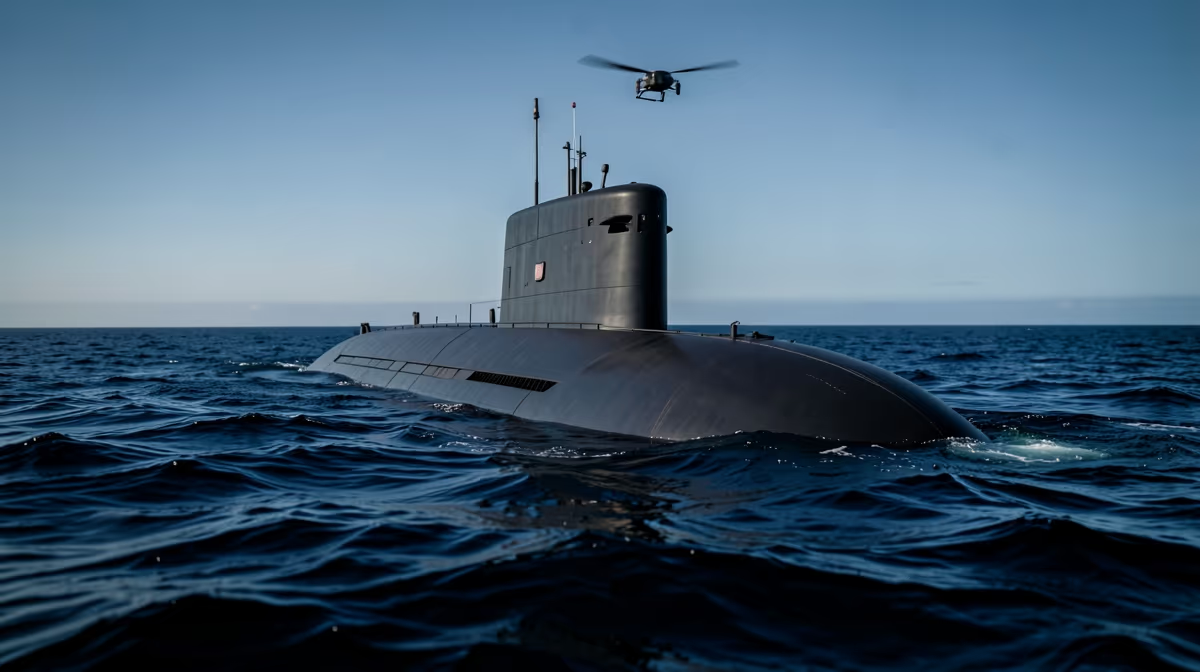
The United States Navy is closely monitoring newly deployed anti-drone defense systems on Russian submarines operating in strategic international waters, as Pentagon officials confirmed Friday that Moscow is adapting underwater warfare tactics in response to the proliferation of unmanned aerial and maritime vehicles. russian submarine anti-drone defenses have become a critical focus as underwater drone warfare evolves rapidly across global oceans, signaling a massive shift in how capital military assets survive in contested environments.
Defense analysts report that Russian naval engineers have begun integrating specialized electronic warfare suites and localized point-defense capabilities onto newer submarine classes. These modifications are specifically designed to counter the growing threat posed by low-cost, high-yield drone technology that has altered modern naval combat dynamics over the past three years. The emergence of these defensive measures highlights a broader shift in global naval strategy, where traditional subsurface platforms are increasingly vulnerable to surface-level and aerial autonomous threats. U.S. Indo-Pacific and European Command planners are currently assessing the tactical implications these additions pose to allied anti-submarine warfare operations.
While details regarding the precise operational effectiveness of the systems remain classified, commercial satellite imagery and intelligence reports corroborate the structural modifications on at least two active-duty Russian vessels. Military officials emphasize that allied forces are updating their own targeting algorithms and engagement protocols to maintain strategic deterrence. This rapid proliferation of asymmetric maritime drone warfare in the Black Sea and Indo-Pacific has exposed critical vulnerabilities in Russian submarine basing and transit, forcing Moscow to rapidly adapt legacy platforms against low-cost, high-impact aerial and surface threats.
Evolution of Naval Anti-Drone Systems
Russia is currently working on adding new anti-drone defenses to its military submarines. As modern warfare increasingly relies on flying drones for surveillance and attacks, even underwater vessels need ways to protect themselves when they surface or operate near the coasts. These new defense systems are designed to detect, track, and shoot down aerial drones before they can drop explosives or gather sensitive intelligence on Russian submarine fleets. This is a major shift, as submarines traditionally worried about enemy ships and torpedoes rather than flying robots.
The historical parallel to this scramble is found in the hasty installation of anti-torpedo nets and barrage balloons on capital ships during the early phases of World War I, as traditional naval powers scrambled to counter disruptive asymmetric innovations like early submarines and mines. Today, the timeline of adaptation has accelerated dramatically. Back in 2022, Ukrainian uncrewed surface vessels successfully struck Russian naval assets in Sevastopol, shocking naval planners. By 2023, satellite imagery revealed improvised chain-link anti-drone cages appearing on Russian Kilo-class submarines at Black Sea berths.
The evolution continued into 2024 with the integration of portable electronic jamming gear and enhanced surface-to-air point defense capabilities directly onto submarine conning towers during port stays. Currently, military engineers are developing integrated sensor-jammer masts optimized for detecting low-radar-cross-section loitering munitions hovering over known submarine transit routes. While focus remains on kinetic defenses, Russian naval intelligence is quietly weaponizing commercial off-the-shelf drone components recovered from intercepted Western-supplied systems to reverse-engineer indigenous swarming AI algorithms for sub-launched counter-drones.
Strategic Impacts and Geopolitical Realities
The Kremlin leverages the militarization of coastal defenses to project technological resilience domestically, deflecting from the strategic failure of its surface fleet in contested waters and reinforcing the narrative of a besieged nuclear superpower. However, the economic reality behind these deployments involves the diversion of state defense procurement funds toward improvised anti-drone mesh netting, acoustic decoys, and localized electronic warfare systems. This ongoing spending strains an already overextended military-industrial complex currently prioritizing heavy armor and missile production.
Geopolitically, these modifications accelerate a global cat-and-mouse game in undersea surveillance and strategic choke points, prompting the U.S. Navy to recalibrate its own submarine espionage tactics and accelerate counter-unmanned underwater vehicle capabilities in the GIUK gap and Arctic. Expert predictions indicate that Russia is likely accelerating the integration of acoustic and electronic anti-drone systems on its submarine fleet to counter expanding U.S. unmanned undersea surveillance, prompting a technological arms race in asymmetric naval warfare.
For the United States Department of Defense, the Russian Ministry of Defense, and the US Navy Office of Naval Intelligence, these developments alter impact areas across undersea warfare strategy and unmanned underwater vehicle development. The best-case scenario is that this development prompts enhanced U.S. technological innovation in stealth and autonomous evasion, leading to more resilient underwater surveillance platforms without direct escalation. Conversely, the worst-case scenario involves miscalculation or aggressive encounters in contested international waters escalating tensions, leading to a tit-for-tat targeting of unmanned assets by both superpowers.
Tactical Implementation and Future Horizons
As defense analysts, military strategists, and cybersecurity professionals track these global geopolitical technology shifts, the operational deployment of these defenses continues to expand. U.S. intelligence agencies and naval commands will monitor and assess intelligence reports regarding newly deployed Russian submarine anti-drone countermeasures over the next 24 hours. Following that window, defense analysts and naval strategists will begin tabletop exercises and briefings within the next 72 hours to evaluate the operational implications of these defenses on U.S. underwater drone capabilities.
The integration of these systems confirms that no military asset is safe from the drone revolution, forcing major powers to rethink how they protect multi-billion-dollar weapons systems. For the United States and its allies, it means submarine hunting and intelligence gathering will become much more complicated as Russian vessels adapt to new aerial threats. US military planners, NATO naval forces, and defense contractors developing drone and counter-drone technology remain directly affected by this ongoing maritime evolution.
Frequently Asked Questions
How are Russian submarines defending against marine drones?
Russian submarines are increasingly relying on enhanced port security measures, including floating boom barriers and increased patrols, to protect stationary vessels. Additionally, naval planners are exploring the integration of close-in weapon systems and electronic warfare suites to disrupt drone guidance signals. These multi-layered defenses aim to counter the growing threat posed by asymmetric uncrewed surface vessels.
Can Russian submarines shoot down aerial drones?
While modern Russian submarines are primarily designed for underwater warfare, some classes have been experimentally fitted with shoulder-fired surface-to-air missiles operated by crew members on the conning tower. However, this is a risky and limited tactic used only in absolute emergencies when surfaced or near port. Submarines generally rely on remaining submerged and avoiding detection rather than engaging aerial drones directly.
What role does electronic warfare play in Russian submarine anti-drone strategy?
Electronic warfare is critical for jamming the communication and GPS navigation links that uncrewed surface and aerial drones rely on to operate. Russian naval bases utilize shore-based jamming equipment to disorient approaching autonomous threats before they can reach docked submarines. At sea, newer vessels are expected to incorporate advanced electronic countermeasures to confuse incoming drone sensors.
Are Russian submarines vulnerable to underwater drones?
Yes, uncrewed underwater vehicles represent one of the most significant emerging threats to modern submarine fleets, including those of Russia. Because traditional sonar is optimized for detecting other submarines or surface ships, small stealthy UUVs are very difficult to spot. Consequently, the Russian Navy is actively researching better acoustic sensors and mine-like countermeasures to protect ports and high-value subs.
What countermeasures are used at Russian naval bases to stop drones?
Russian naval bases, particularly in the Black Sea, have heavily reinforced their perimeters with multiple layers of physical barriers such as heavy nets and booms. They also employ armed security boat patrols, rapid-reaction teams, and machine gun nests stationed along the coastline. These visible deterrents are designed to physically block and destroy incoming kamikaze drones before they impact high-value targets.
How effective are Russian anti-drone measures for submarines?
The effectiveness of these defenses has proven mixed, with stationary barriers successfully stopping several attacks while agile drones still manage to penetrate port defenses in some conflicts. Because uncrewed systems are constantly evolving in tactics and autonomy, naval defense strategies require continuous adaptation. Ultimately, hiding submarines in dispersed or heavily fortified locations remains Russia's primary defense strategy.
Conclusion
Verified developments confirm that Russian naval engineers have integrated localized electronic warfare suites, physical structural modifications, and point-defense capabilities onto active-duty submarines to counter low-cost aerial and aquatic drone swarms. While U.S. intelligence and defense commands actively monitor these structural upgrades through satellite imagery and intelligence reports, military planners are systematically evaluating the broader tactical implications for allied anti-submarine warfare operations. Naval forces and defense strategists will continue assessing these technological adaptations as asymmetric warfare transforms the operational dynamics of global underwater fleets.


